





SAP Manufacturing
- Highbar Technocrat
- Blogs
- December 17, 2025
Connect With Us
In the evolving world of manufacturing, one size no longer fits all when it comes to software. Manufacturers deal with very dynamic conditions — everything from fast customer customisation and supply-chain volatility worldwide to regulatory depth and machine-level operation detail.
Under these conditions, operations systems must capture the essence of manufacturing: machines, materials, workers, workflows, quality steps, change orders, multi-plant coordination, and real-time data.
That’s why verticalized ERP, targeted manufacturing-specific software, becomes strategically significant. What we mean by SAP manufacturing and SAP Manufacturing software is solutions that grasp manufacturing processes, not generic business processes.
Such solutions connect the language of the shop floor, the planning room, the supplier network, and the field service team. Generic ERP software might report finance, HR, procurement, but not deeply enclose production logic, traceability, machine usage, or multi-mode manufacturing (make-to-stock, make-to-order, engineer-to-order).
Manufacturers today need precision, speed, flexibility — and their software has to provide just that.
The Failures of Generic ERP for Manufacturing
1. Inadequate Shop Floor Control
Generic ERP systems typically shine in basic business operations but provide limited shop-floor support. For instance, monitoring work order status, equipment utilisation, quality checkpoints, and production cycle times are not their core design.
Without intimate shop-floor connectivity, manufacturers experience time-lagged insights and reactivity instead of proactivity.
2. Heavy Customisation Requirements
In order to adapt a generic ERP system to manufacturing, organisations usually have to spend a great deal of money on customisation. Long implementation cycles, steep consulting fees, heavy support load and frequent upgrades become the rule. Despite customisation, the system can still be inflexible when the business model changes or when production processes change.
3. Inadequate System Integration Shatters End-to-End Visibility
Operations in manufacturing produce data by the second — from machine sensors, operator activity, warehouse systems, QC equipment, and supply-chain activities.
When the ERP has no way to include all of this, organisations are back to relying on spreadsheets and manual reporting.
The end result: breakaway visibility, operational blind spots, and slower decision-making. Industry experts highlight that “industry vertical ERP ensures tools tailored directly to the business processes of each industry.”
4. Inadequate Flexibility for Alternative Production Models
Manufacturers generally run in one or more of these models: make-to-stock (MTS), make-to-order (MTO), engineer-to-order (ETO), or hybrid/mixed-mode. Standard ERPs usually accommodate standard models; to adjust them to accommodate complicated or mixed manufacturing patterns results in workarounds, obfuscation, and incompetence.
Bottom line: generic ERP systems don’t speak the language of manufacturing — and manufacturing can’t afford to be misunderstood.
What Makes Verticalized ERP the Right Fit
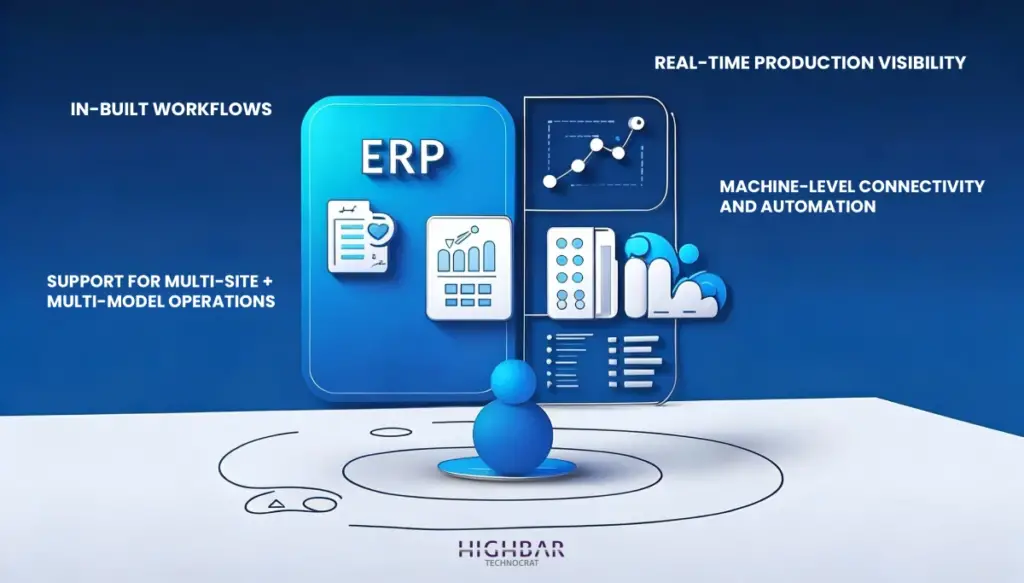
Verticalized ERP solutions such as SAP Manufacturing software come with manufacturing-specific logic, processes and integrations built. They are built from the ground up with manufacturing best practices, which reduces customisation and gives better time-to-value.
Main Benefits Are:
1. In-Built Manufacturing Workflows
SAP Manufacturing software has in-built processes such as:
- Material Requirements Planning (MRP) and capacity planning
- Detailed Production Scheduling
- Shop Floor Execution
- Preventive & Predictive Maintenance
- Batch Management & Traceability
- Quality Management & Compliance Control
These abilities enable manufacturers to embrace best practices instead of reinventing them.
2. Real-Time Production Visibility
A verticalized structure combines business planning (ERP), execution (MES) and automation (IoT/machines). This allows manufacturers to see operations in real time, detect bottlenecks, correct deviations in real time and improve performance on a continuous basis. As per SAP, customers in the industry depend upon ERP to deliver “real-time information and effective business processes” especially in manufacturing.
3. Machine-Level Connectivity and Automation
SAP Manufacturing software integrates directly with plant-floor systems, providing automatic data capture, reduced manual entry, improved decision cycles, and reduced errors. With embedded analytics and connected machines, manufacturers have visibility into machine health, throughput, and utilisation.
4. Support for Multi-Site + Multi-Model Operations
Regardless of whether the business is running in a single plant, across several factories geographically, contract manufacturing partners, or mixed production methods, SAP Manufacturing offers the basis to standardise core processes, stay visible, and accommodate local differences. This guarantees process, quality and reporting consistency regardless of the complexity of the footprint.
Business Benefits Manufacturers Achieve
Manufacturers using SAP Manufacturing software frequently see measurable business gains:
- Business Area\t impact
- Production Efficiency \t Throughput increases of +10-35%
- Inventory Accuracy\t Increased accuracy of up to 95-99% in real-time visibility
- Quality Performance\t Reduced reject rates, reduced reworks
- Downtime Management Unplanned downtime is minimised through forecasting maintenance
- Customer Responsiveness\t Better-quality lead times, improved delivery reliability
- Cost Optimisation \t Less waste, improved resource use
These are more than system updates — they equate to competitive edge, increased margins, and manufacturing resiliency.
How SAP Manufacturing Software Transforms Operations
SAP Manufacturing software allows manufacturers to create a fully connected factory environment—a system of systems integrating business, production and supply chain into a cohesive whole.
Core Features Include:
- Real-time dashboards & OEE monitoring
- Digital work instructions and operator guidance
- Automated material & production tracking
- Demand-driven planning and development
- Integrated quality management and compliance record-keeping
With this as the foundation, manufacturers can proceed to smart factory levels: full automation, predictive analytics, AI-assisted decisions and Industry 4.0 readiness.
Case studies and industry reports reveal SAP S/4HANA and consistent manufacturing solutions as market leaders in manufacturing-specific ERP capability.
Conclusion: More is Required from Generic Tools to Achieve Manufacturing Excellence
In the current manufacturing landscape, agility, insight, and integration are no longer a choice but a requirement. Generic ERP systems, with a breadth of business process coverage as their design brief, simply cannot match the complexity and requirements of manufacturing.
By choosing verticalized ERP built for manufacturing – such as SAP Manufacturing software – companies gain far more than an operational system: they gain a strategic foundation for growth, competitiveness and innovation. This means:
- Real-time visibility across the enterprise
- Precision in managing production, quality, and maintenance
- Flexibility to scale operations and production models
- Integration of machines, people, supply chains and data
Resilience in facing market disruptions, cost pressure and customisation demands
Those manufacturers who invest in industry-specific ERP will not only get streamlined operations—they will drive the next wave of manufacturing innovation. Because in manufacturing, software needs to mirror the factory, not make the factory conform to the software.
Comments
