





ERP system infrastructure
ERP-Led Risk Forecasting: Preventing Claims, Penalties & Liquidated Damages with “ERP System Infrastructure”
- Highbar Technocrat
- Blogs
- March 19, 2026
Connect With Us
In large infrastructure programs, risk is not an occasional event it is a constant presence. Delays, scope changes, cost escalations, contractual disputes, and compliance lapses are all part of the execution reality. What separates successful infrastructure organisations from struggling ones is not the absence of risk, but the ability to forecast and manage it early.
Yet many EPC contractors, developers, and public sector authorities continue to rely on reactive approaches to risk management. Issues are identified only after claims are raised, penalties imposed, or liquidated damages (LDs) triggered. By the time leadership is aware, the financial and reputational damage is already done.
This is where ERP-led risk forecasting, enabled by ERP system infrastructure implemented by Highbar Technocrat, plays a decisive role—shifting organisations from dispute response to risk prevention.
The True Cost of Claims, Penalties, and Liquidated Damages
The public considers both claims and penalties to be essential outcomes that result from major infrastructure developments. The actual situation demonstrates that these problems arise from fundamental deficiencies which exist in visibility, coordination and control mechanisms.
When risks are not identified early:
- Claims escalate into prolonged disputes
- Liquidated damages can erode the already narrow margins of business companies.
- Counter Parties and authorities may build stronger barriers.
- Signals of doom light up in leadership owing to failed forecasts and reports.
However, organisations swiftly go into defence mode rather than creating, delivering, and capturing the actual value.
Infrastructure projects require comprehensive risk management solutions, which traditional risk registers, spreadsheets and project tools fail to provide. Modern risk assessment needs enterprise-wide intelligence systems to track its cross-functional and data-driven nature, which has become dynamic.
Why Traditional Risk Management Approaches Fail in Infrastructure Programs
1. Risks Are Tracked in Isolation, Not in Context
Traditional risk management methods depend on permanent risk registers, which exist apart from operational systems. The registers fail to show actual project status because they do not track current conditions like delayed procurements and cash flow issues, equipment failures and subcontractor work quality.
2. No Early Warning Signals for Claims Exposure
Claims do not emerge overnight. They build up through:
- Schedule slippages
- Scope ambiguities
- Payment delays
- Resource misalignments
Organisations require integrated data systems that connect their planning, contracts, finance, and execution operations because these systems enable organisations to detect emerging claims and penalty risks at an early stage.
3. Fragmented Ownership of Risk
In most infrastructure organisations, risk is everyone’s responsibility—and therefore, the project teams, finance, contracts and legal functions use separate systems which produce different reports. The separate operational systems of the different teams create incomplete visibility.
The present situation creates two distinct problems which need to be resolved through binding measures.
4. Reactive Compliance and Contract Governance
Initiating liability rules and fines are definitely required where there is only a breakage in the yardstick, but not one where contractual responsibilities are left unkept or certification requirements remain unmet.
The manual tracking process of milestones and approvals, together with documentation requirements, increases the risk of non-compliance, which particularly affects government and PPP projects.
ERP-Led Risk Forecasting: A Structural Shift
ERP-led risk forecasting represents a fundamental shift in how infrastructure organisations handle unpredictable situations. The organisation integrates risk intelligence into its main business operations instead of developing risk management systems as an afterthought.
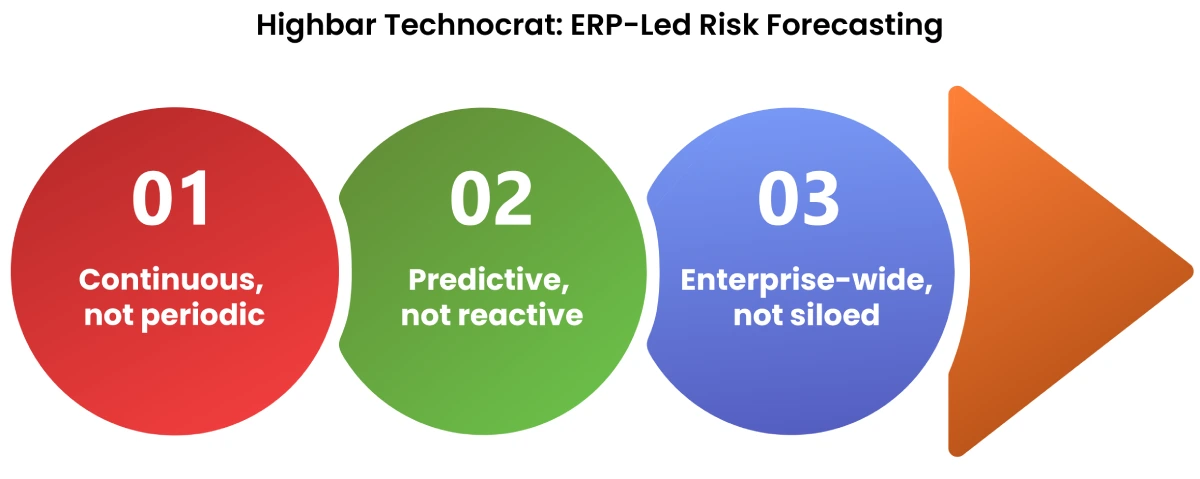
With ERP system infrastructure deployed by Highbar Technocrat, risk forecasting becomes:
- Continuous, not periodic
- Predictive, not reactive
- Enterprise-wide, not siloed
The focus moves from documenting risks to preventing financial exposure before it materialises.
How "ERP system infrastructure "Enables Proactive Risk Forecasting
Integrated Visibility Across Projects, Finance, and Contracts
The core element of ERP-driven forecasting requires systems to work together. The ERP system framework combines project execution data with financial obligations, billing progress, procurement information, and contract requirements.
Organisations use this integration to discover two types of information.
The first type involves schedule delays, which create potential liabilities.
The second type identifies budget overspending that occurs because of project scope modifications.
The third type of information reveals cash flow problems, which reduce vendor performance.
Risks are detected while there is still time to act.
Real-Time Monitoring of Cost and Schedule Variances
The main reason people make claims in construction projects happens because they experience both cost and time overruns. SAP provides ongoing monitoring capabilities which compare actual expenses with budgeted amounts and Bill of Quantities and project timelines to show budget variances as they happen.
The project leaders receive immediate project information, which entitles them to take preventive measures against potential conflicts.
Contract-Centric Risk Intelligence
The complex structure of infrastructure contracts results in concealed risk factors, which become embedded within the contractual agreements. Project milestones and contract changes need to be defined for the project. The operational restrictions of a business emerge from its need to meet both penalty systems and compliance requirements.
The following are the consequences of this situation:
- Early identification is available for potential penalty triggers.
- Immediate assessment is done for variation impacts
- Claims exposure is now measurable, not speculative.
Predictive Insights Instead of Historical Reports
ERP-driven risk forecasting is not about creating more reports it is about anticipating outcomes. By analysing trends across projects, vendors, and asset classes, ERP system infrastructure helps organisations recognise recurring risk patterns.
This enables leadership to address systemic issues rather than firefighting individual incidents.
Governance, Compliance, and Audit Readiness
The organisation operates its governance system through SAP, which handles approval processes and document management and creates audit records of its operations. The solution protects organisations from incurring financial penalties because it decreases their chances of violating regulations.
Why ERP-Led Risk Forecasting Matters for Leadership
For executive teams and boards, dues and penalties are more than operational issues. They are strategic risks. When disagreements are frequent, financial predictability is destabilised, and credibility with the government is compromised.
By adopting ERP system infrastructure through Highbar Technocrat, leadership gains:
- Forecast assurance
- Program transparency
- Early warning of financial risk
- Greater control over outcomes
Most importantly, risk management evolves from a defensive function to a strategic capability.
From Claims Management to Risk Prevention
The infrastructure sector is moving toward larger programs, tighter contracts, and greater scrutiny. In this environment, managing claims after they arise is no longer sustainable.
Organisations must prevent claims by:
- Detecting risk early
- Acting on real-time data
- Aligning execution with contracts and finances
This transformation is only possible when risk forecasting is embedded within the ERP backbone not managed on the sidelines.
Conclusion: Building Resilient Infrastructure Through ERP-Led Intelligence
Claims, penalties, and liquidated damages are not inevitable. They are often the result of delayed visibility, fragmented systems, and reactive decision-making.
ERP-led risk forecasting, powered by ERP infrastructure platforms and implemented by Highbar Technocrat, enables infrastructure organisations to anticipate risk, intervene early, and safeguard margins and reputation.
In an era where infrastructure programs define national growth and organisational credibility, the ability to forecast and prevent risk is no longer optional. It is a core requirement for sustainable, large-scale delivery.
Comments
