



SAP software
Key Factors to Consider When Selecting an SAP Managed Services Provider
- Highbar Technocrat
- Blogs
- June 12, 2026
Connect With Us
Deployment of SAP is just the start. The true test begins post-go live, when the operational teams expect the application to function well, provide accurate reports, solve any issues rapidly, and accommodate changing business needs without impacting their day-to-day activities.
That is where most organisations begin to feel the pressure.
At first, internal teams try to manage everything themselves: user tickets, data issues, minor enhancements, role changes, system monitoring, and periodic fixes. For a while, it works. Then complexity rises. More users come on board. More transactions flow through the system. More departments rely on it. One unresolved issue is affecting finance. A delayed update slows procurement. A missed alert disrupts operations.
Suddenly, SAP software is no longer just a business system. It becomes a system that needs active, disciplined, and intelligent management, and that is why the choice of an SAP managed services provider matters so much.
The right partner will ensure that continuity of business is maintained, system efficiency is improved, and SAP continues to provide value. However, the wrong partner will make the support of SAP a never-ending process of frustration. This is the reason the choice of the right partner should not only be based on pricing and capability.
What Goes Wrong Without the Right SAP Support Model
Many organisations assume the hard part ends at go-live. In reality, post-go-live brings a different kind of challenge.
Users need ongoing assistance. Reports need refinement. Data discipline must be maintained. Security roles require updates. Integrations need monitoring. Business processes evolve. Leadership expects better visibility. And whenever the system slows or breaks, the business feels it immediately.
In the absence of an appropriate structure in the system, there are three common tendencies:
- Reactionary support is initiated.
Issues only surface when a user makes you aware of the problem that has already taken place.
- Process understanding remains restricted.
The technical solutions help solve problems but do not resolve the underlying causes of such problems, especially in the fields of finance, procurement, projects, and operations, where the problems are module-specific.
- Enhancements pile up.
Change requests, optimisations, and upgrades sit in queues because the provider is built for break-fix only, not for improvement.
In short, businesses do not struggle because they lack SAP software. They struggle because they lack the right support structure.
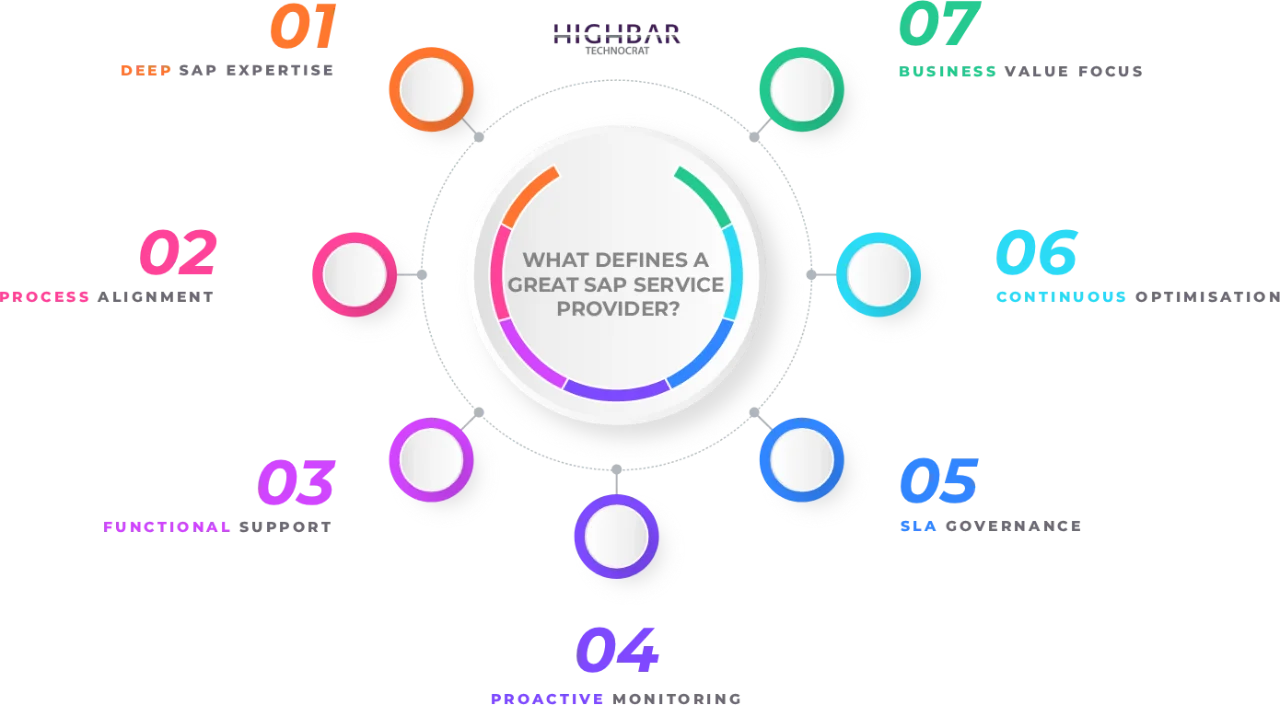
Seven Criteria That Differentiate Good Service Providers from Poor Ones
Professional qualifications do not suffice. It comes down to whether a service provider can sustainably provide value, promote usage, and facilitate the evolution of the system with the enterprise.
1. Depth of SAP expertise
A managed services provider must understand SAP software well beyond basic administration. The team should be able to operate across functional and technical layers, process design, configuration, performance monitoring, integrations, and user-level support.
This is important for the reason that SAP problems never confine themselves to one single area. A problem in a finance posting transaction may stem from the master data. A problem with procurement may be a consequence of the underlying workflow logic. Only a provider with experience can see through the connection and sort it out effectively.
2. Combined functional and technical SAP support capability
Businesses need functional support to resolve process-related issues. They also need technical support for BASIS, ABAP, integrations, workflows, and infrastructure concerns. When a provider handles only one side, resolution quality suffers, tickets bounce, root causes get missed, and users lose confidence.
The best providers have both. And that is precisely what distinguishes the quality of SAP support: faster, better, and linked directly to tangible results.
3. Anticipatory support rather than ticket resolution
Some firms assess their providers based on their response time to help with tickets. But then the damage has been done already.
A mature SAP managed services provider monitors jobs, systems, integrations, and performance trends not to resolve incidents, but to prevent them. Teams stop working in panic mode. Early warning signs get addressed before users notice them. Time stops being lost in escalation chains.
That shift from reactive maintenance to operational assurance is one of the clearest signs of a serious provider.
4. Alignment with business processes
Support is meaningless unless it ties back to business outcomes. The provider must understand the nature of the business: which transactions are critical, how processes depend on each other, and what simply cannot wait until the next morning at month-end.
Without such information, support remains abstract. Once you have it, the provider will be part of the business itself, and SAP will perform as it should.
5. Clearly Defined SLAs and Escalation Governance
Responsiveness is promised by all providers, but few have actually defined what this means. The following guidelines will help you clarify things before making any commitments:
- What is the time lag in recognizing an important problem?
- What is meant by prioritization?
- Who is involved in escalations?
- What about what happens outside office hours and during holidays?
- How can a similar mistake be avoided in the future?
Most SAP support partnerships fail due to a misunderstanding of the expectations, not a lack of commitment.
6. Capability for upgrades, enhancements, and long-term optimisation
Support is not only maintenance. Over time, businesses need to report changes, process refinements, version upgrades, role redesigns, and stronger user adoption. A weak provider handles break-fix only. A stronger provider helps the business continuously extract more value from SAP software.
The right question is not “Can they keep things stable?” It is “Can they help us mature?”
7. Focus on business continuity and value extraction
The best providers do not measure themselves by the number of tickets closed. They measure themselves by business continuity, user confidence, adoption quality, and the system’s overall effectiveness.
A good provider keeps the system running. A better provider helps the system keep delivering value, and that distinction shows up in productivity, compliance, reporting accuracy, and leadership trust.
Why Provider Selection is a Strategic Decision
Provider selection for SAP managed services is not a mere back-end IT decision. The speed at which solutions can be implemented, process efficiency, employee comfort, and scalability of the enterprise all hinge on this decision.
This is the reason why the assessment needs discipline. Look for SAP proficiency, reactivity, process knowledge, proactive surveillance, improvement ability, and good governance. Look for a business partner that does not view SAP as just a technical platform but rather as a dynamic component in business execution.
This is also where partners like Highbar Technocrat earn their place in the conversation. As an SAP Gold Partner with more than 14 years of experience and a heritage rooted in Hindustan Construction Company (HCC), Highbar combines deep SAP expertise with strong domain knowledge in infrastructure, EPC, real estate, construction, and manufacturing. Its portfolio spans ERP implementation, business process consulting, ERP maintenance and SAP support services, system integration, and SAP training backed by CMMI Level 5-certified delivery and recognition, including the SAP New Net Business Partner of the Year award in 2024.
That kind of breadth, process expertise, industry depth, and long-term support is exactly what businesses should expect from a managed services partner.
Conclusion
SAP can transform your business. But SAP alone cannot sustain that transformation it needs a managed service model built around it. Done well, that model delivers reliability, agility, process knowledge, and strategic continuity. Done poorly, it creates delays, vulnerabilities, and user frustration.
The success of SAP systems will not depend only on their implementation; it will also depend on management after implementation. Pick carefully, and you’ll get far more than just improved SAP services. You’ll get improved management, improved sustainability, and improved business results.
Related Blogs