
Menu




In a world where clients demand quality, regulators demand liability, and global competition keeps constriction margins, traceability has become the new pillar of modern manufacturing. Gone are the days when a paper track could satisfy an audit or when quality control was completed at the inspection desk.
Today’s manufacturers need comprehensive visibility—from raw material tracking to finished goods delivery—to build trust, meet compliance standards, and take preventive measures to protect brand reputation. This is where SAP Manufacturing, powered by Highbar Technocrat, plays a transformative role.
Traceability is the process of having complete knowledge of every single part’s origin, its manufacturing, and finally its destination. It is basically the monitoring and the recording of every single product’s life story that’s living in the market.
Regulatory Compliance: The increasing safety and environmental regulations are the main reasons for the manufacturers’ demand for the provision of confidentiality through detailed audit trails. In the case of ISO 9001, IATF 16949, or domestic quality laws, traceability is the key to compliance.
Quality Assurance: It is not possible to avoid all defects; however, they can be confined to a specific area very quickly. With the help of traceability, one can detect which batch, shift, or supplier was at fault, thus cutting down the cost of recalls and rework.
Customer Trust: Transparency is the basis of brand trust. If you can assure the consumers that your products are of good quality, are ethically sourced and have been produced using customer-friendly techniques, you will get their loyalty and repeat purchasing.
Sustainability & ESG Goals: International consumers are more and more demanding regarding the product’s ecological impact and the ethical aspects of the supply chain. Manufacturers using traceability can get the sustainability metrics they need for their project, measuring, reporting, and improving.
The situation is that even if all the mentioned aspects need to be taken care of, the majority of the Indian manufacturers still have to cope with difficulties that are really deep-rooted in the manufacturing sector:
The result? Missed deadlines, regulatory risks, and reduced customer confidence.
At Highbar Technocrat, we’ve seen firsthand how a well-implemented SAP ERP Manufacturing system transforms chaos into control.
Let’s look at how it works:
Every material—from the raw component to the final assembly—is assigned a unique identification code in SAP Manufacturing. This code follows it through procurement, storage, production, quality checks, and shipping.
For instance:
A material that is not processed yet is referred to as raw material, and its batch number gets recorded as soon as it is received at the factory.
The production process that the item goes through is recorded along with the machines, operators, and tools used to handle it, thanks to the ERP system.
Thus, the manufacturer is able to keep a complete digital record of the item’s journey when it finally reaches the customer.
The Quality management system that comes with SAP ERP Manufacturing has the quality control modules built in that connect inspection plans, test results, and non-conformance reports directly to the production batches.
In this case, if a single component does not pass the inspection, you know immediately who the supplier is that provided it, which batches it went into, and which customers are potentially affected.
Manufacturers no longer have to rush through their files when an audit comes; they can instead produce an audit trail that is automated, along with the timestamps, process data, and operator details.
This not only lessens audit stress but also shows effortlessly that quality and safety standards are in place.
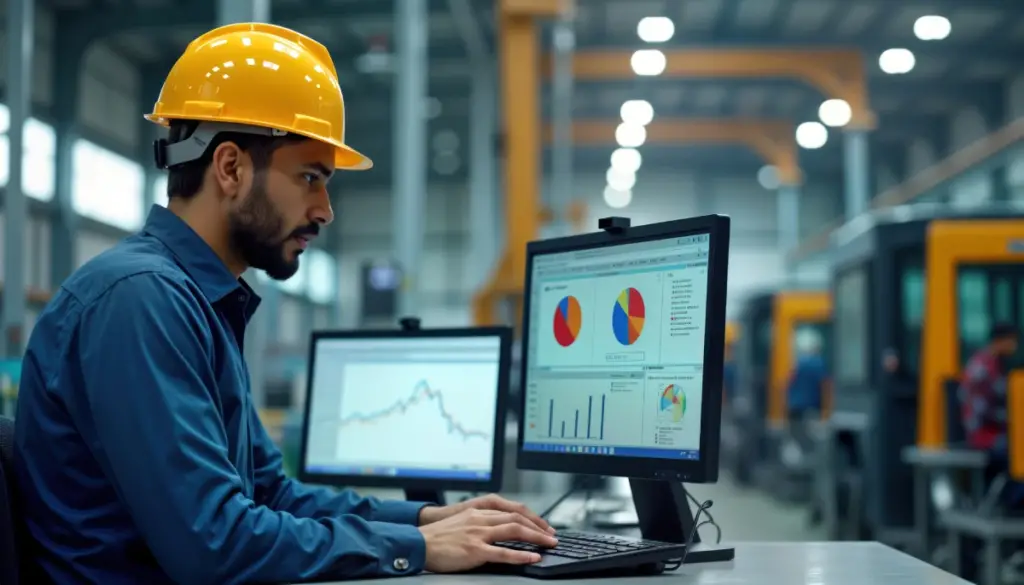
The real-time prominence of the factory floor, provided by SAP Manufacturing, is accomplished through the integration of IoT data (from sensors and machines) and ERP analytics.
Machine temperature, material flow, and production competence can all be monitored in real time. Signals are then activated instantly if there is any deviation, thereby helping to stop quality lapses before they reach the customer.
In the rare event of a product issue, SAP ERP Manufacturing allows you to trace exactly which materials or batches were affected and initiate targeted recalls instead of broad, costly ones.
This precision protects both profits and reputation.
At Highbar Technocrat, we believe ERP implementation isn’t just a software project—it’s a transformation journey.
In a nutshell, our service for manufacturers is to carry out the tracking only by making control, compliance, and customer trust the main points of the entire process.
Imagine an auto-component manufacturer that supplies multiple OEMs across India.
Without ERP, a customer complaint about a faulty batch would mean days of manual checks, paper records, and confusion.
Instead of disruption, the company demonstrates accountability—turning a potential crisis into proof of reliability.
As Indian manufacturers expand globally, compliance expectations are rising fast. Markets in the EU, the US, and Asia-Pacific demand transparent traceability aligned with environmental and ethical sourcing standards.
SAP Manufacturing makes it easier to meet and maintain these evolving requirements by providing:
With Highbar Technocrat’s SAP ERP Manufacturing solutions, Indian manufacturers can confidently compete—and comply—on the world stage.
In modern manufacturing, traceability isn’t optional—it’s essential. It safeguards compliance, strengthens customer confidence, and positions your brand as transparent and trustworthy.
SAP Manufacturing, implemented by Highbar Technocrat, delivers that power through data-driven visibility, automated audit trails, and intelligent analytics.
It turns every product into a story of quality, every process into a proof of compliance, and every factory into a symbol of trust.
When your operations run on Highbar Technocrat’s SAP ERP Manufacturing solutions, you don’t just track what you make—you prove how well you make it.
