
Menu




Manufacturing companies restructure how they operate across borders in today’s Industry 4.0 world. As establishments grow from single-site operations to multi-plant ecosystems, coordination, production planning, and data visibility are developing into increasingly complex.
It is at this point that SAP Manufacturing solutions develop as the transformative force, enabling a manufacturer to accomplish efficient scaling, standardisation of processes, and real-time visions across facilities around the world.
Manufacturing companies usually face common operational challenges in their quest to expand internationally.
These come about because IT systems are fragmented, workflows are non-standardised, and data repositories are siloed.
Management loses visibility into overall enterprise performance when every plant operates in isolation with its set of software tools and reporting structures.
Disconnected systems result in:
These pain points make it crystal clear that, in order for the manufacturing organisation to operate as truly worldwide, it requires one integrated digital core: an intelligent, integrated system linking every plant, supplier, and customer along the value chain.
And that’s precisely what SAP ERP Manufacturing, especially through the cloud-enabled SAP S/4HANA Cloud and RISE with SAP, offers: one single platform where data, processes, and operation indicators are harmonised across all facilities, ranging from the purchasing of raw materials to the distribution of finished goods.
Cloud ERP allows manufacturing businesses to accomplish production, logistics, finance, and quality from a connected platform. Every plant becomes part of a coordinated network operating with agility and data-driven accuracy.
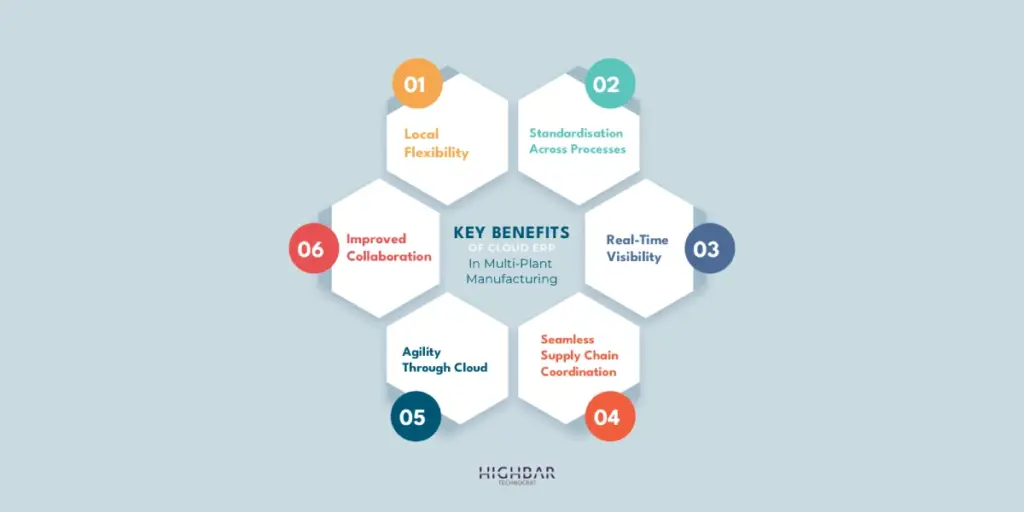
SAP Manufacturing gives global organisations the ability to operate from one enterprise framework, yet remain adaptable to meet regional requirements.
It allows the corporate headquarters to enforce global standards while simultaneously allowing the local plants to configure the workflows and taxation compliance to suit regional requirements.
Consistency is key to scaling operations. SAP ERP allows producers to implement the same processes across all services in areas such as production planning, quality checks, and inventory control.
Standardisation decreases duplication, makes training easier, and increases acquiescence across the board.
In addition, with in-memory computing and analytics capabilities of SAP S/4HANA, the managers/executives of plants will be able to obtain, in real time, the status of their operations across different geographies.
Dashboards form an integral feature of SAP Analytics Cloud and Power BI-as integrated by partners-for instant insight into KPIs like machine uptime, order fulfilment, and cost of production.
A linked supply chain is integral for multi-plant efficiency. Similarly, combined elements like SAP Materials Management (MM), Production Planning (PP), and Sales & Distribution (SD) ensure that demand forecast, procurement, and logistics function in complete coordination.
For example, raw material deficiency in one plant may generate an automatic inter-plant transfer or even a supplier reorder.
Cloud ERP lets manufacturers scale their operations without the need for heavy IT infrastructure. New plants or subsidiaries can be onboarded in the least time, with pre-configured industry templates.
Companies are able to implement ERP in half the time, as evidenced by Highbar Technocart’s SAP-certified rapid deployment solutions, enabling quicker go-lives and faster returns on investment.
Cloud ERP drives alliance through the usage of mobile-enabled applications, such as SAP Fiori, to provide real-time information to all levels of decision makers and shop floor operators. This ensures that problems are determined more quickly and that production cycles are maintained without downtime.
The evolution from localised systems to an integrated, cloud-based ERP atmosphere involves much more than just executing software; it’s strategic in nature. Therefore, manufacturers will have to align their business objectives, operational processes, and data governance policies across their global plants.
Highbar Technocrat, a SAP Gold Partner and one of the leading Indian digital transformation companies serving the manufacturing, EPC, and infrastructure verticals, brings domain knowledge and technology proficiency to drive businesses toward operational excellence.
Highbar Technocrat brings experience from more than 200 SAP ERP implementations worldwide, providing end-to-end services in business development re-engineering, system integration, and post-application support.
Its preconfigured SAP templates for manufacturing facilitate faster adoption of best practices and adaptability to unique organisational needs.
Out-of-date ERP generally struggles to scale with development into new sections or product lines; cloud ERP overwhelms this through modularity, automation, and smart data management.
For example, when an industrial company adds a new facility in another country, SAP ERP is able to replicate standard formations, roles, and workflows directly.
This will ensure that the new plant aligns with global operations while continuing to comply with local financial and legal norms.
AI-powered insights further enable leaders to anticipate demand, predict maintenance needs, and optimise workforce allocation across plants-in effect, making scalability a strategic differentiator.
Standardisation of processes within global manufacturing is not only an operational necessity but has also become a key differentiator in competitiveness.
Consistent manufacturing practices ensure uniform quality of product, improved customer satisfaction, and faster compliance audits.
SAP ERP brings to the forefront the unification of the entire production spectrum in every single plant by means of role-based workflows, automatic quality checks, and integrated documentation systems.
The outcome is a manufacturing ecosystem that is predictable, repeatable, and efficient, thereby maintaining the global competitiveness of the company.
In other terms, the coming growth wave in the industry is going to connect all the value chain layers, starting from design and procurement to production and customer service. The Cloud ERP is that central nervous system through which all the above-mentioned integration would be done, thus creating and interconnecting the IoT-enabled machines, predictive analytics tools, and human decision-making all on one platform of intelligence.
Continuous innovation by SAP in AI, machine learning, and digital twins allows manufacturers to simulate production scenarios, optimise scheduling, and provide data-driven decisions for improving efficiency and sustainability.
Indeed, the transition from local to global operations is not a matter of just expanding; it is a matter of unification, intelligence, and agility.
SAP Manufacturing, along with SAP ERP Manufacturing solutions, supports organisations in achieving this by providing a centralised digital foundation that links every plant, process, and partner globally.
With visionary implementation partners like Highbar Technocrat, manufacturers can now transform disparate systems into one single integrated enterprise that is able to compete with any in the world.
The result is an operation that is seamless, standardised, and scalable-what the future of intelligent manufacturing truly is.
