
Menu




Real estate projects are complicated beasts. From design approvals through vendor negotiations, construction schedules, compliance testing, and customer commitments, there is room for error only in a hair’s breadth.
And still, most companies use spreadsheets, paper trails, and isolated tools to control projects. Though this might seem “cost-saving” in the short run, the cost of doing project controls manually is astronomical—and usually, not appreciated until it’s too late.
As a partner in ERP implementation in India, Highbar Technocrat has witnessed how such inefficiencies quietly siphon off profits, project delays, and erode stakeholder confidence.
Let’s reveal the unseen costs of manual project controls and how real estate businesses can avoid them with ERP.
When project managers need to chase information between Excel sheets, WhatsApp groups, or email threads, decisions take days rather than minutes.
A delayed approval for vendor billing or material procurement can stall construction work—resulting in timeline overruns and increased costs.
Without automated cost forecasting, budget leakage is a given. Manual systems create problems with the following expenses in real time, which result in mismatches between estimated vs. actual costs.
Variances are identified too late to make changes by the time they’re discovered.
Real estate ventures require scrupulous compliance with RERA norms, safety measures, and environmental approvals.
Manual records raise the likelihood of delayed compliance dates, threatening companies with fines and loss of reputation.
Manual vendor management is susceptible to false billing and duplicate charges. Transparent procurement is frequently hampered by inadequate processes, resulting in increased wastage and conflicts.
Manual project tracking leaves a communication gap with customers. Where updates are irregular or unreliable, customer faith is compromised, disproportionate to future bookings and word of mouth.
ERP is more than software—it’s a strategic enabler of real estate companies. Companies can substitute inefficiency with intelligence by collaborating with an experienced ERP implementation partner in India, such as Highbar Technocrat Limited.
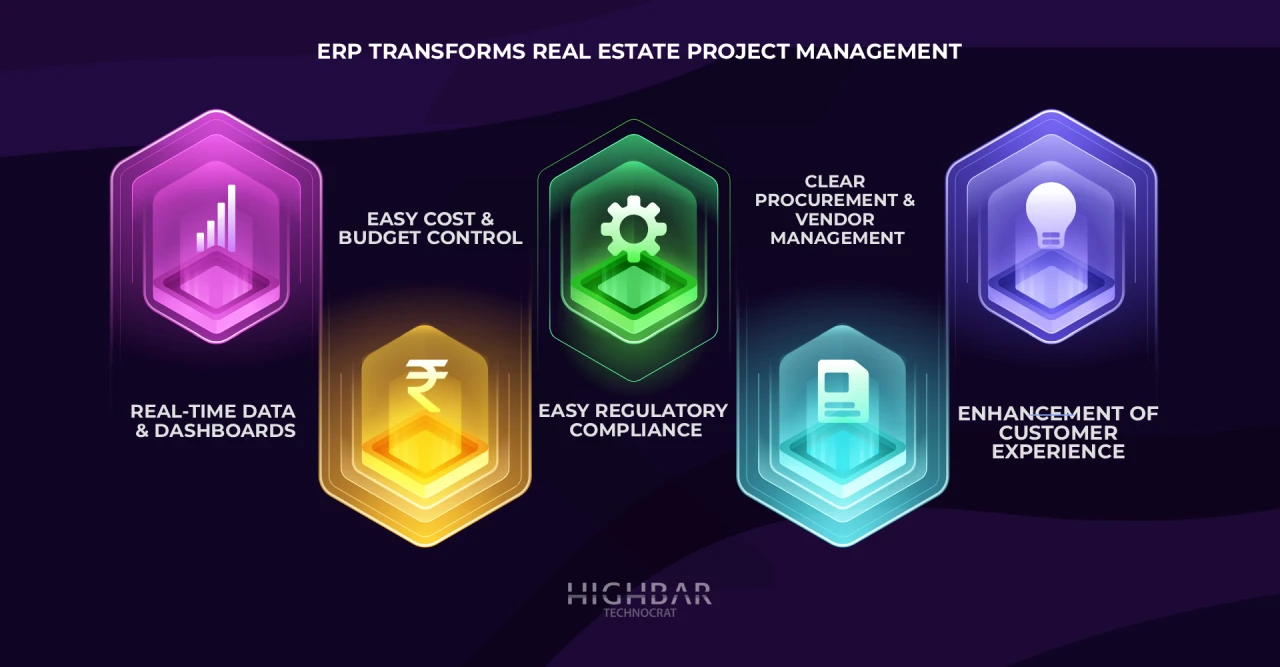
ERP permits centralised dashboards that are accessed by all stakeholders—developers, contractors, and clients—where the same real-time information is observed. This minimises support for manual reports and facilitates decision-making speed.
ERP systems enable automated budget forecasting, expense tracking, and deviation notifications. This keeps projects within budget without incurring expensive last-minute surprises.
In-built modules of compliance ensure organisations remain compliant with RERA and other regulatory requirements. Automated reminders and storage of documents also lower the risk of compliance tremendously.
ERP enhances vendor selection, invoice validation, and payment transparency. With material tracking and approval workflows, wastage and fraud are eliminated.
ERP this allows for automatic project updates. Milestone monitoring and electronic communication. Customers remain in the loop at every step—giving rise to greater trust and long-term loyalty.
One of the top ERP service providers in Mumbai, Highbar Technocrat is a verticalized ERP solutions specialist for the infrastructure and real estate sector.
While generic solution providers offer cookie-cutter solutions, Highbar addresses industry-specific issues such as compliance, vendor management, and bulk project tracking.
With a track record of practical implementations, Highbar makes ERP adoption easy, affordable, and aligned to long-term business objectives.
The price of maintaining manual project controls is much higher than most real estate companies appreciate. From lost hours to overspending and penalties for regulatory noncompliance, these latent inefficiencies quietly sap profitability.
By choosing the right ERP execution partner in India, such as Highbar Technocrat, companies can mitigate these risks and achieve faster, more transparent, and customer-centric project outcomes. If you are looking to transform your real estate business with future-ready technology, it’s time to change beyond manual controls—because the cost of doing nothing is merely too high.
