




SAP Real Estate ERP
How ERP Helps Real Estate Balance Speed & Profit
- Highbar Technocrat
- Blogs
- March 30, 2026
Connect With Us
How ERP Helps Developers Balance Speed, Quality & Profitability
In the real estate development business, organisations generally consider speed a differentiator. Faster launches, faster sales, and faster construction are signs of successful execution, and the market is rewarding speed.
But speed without structure is risk, quality without expense control is weakness, and profitability without discipline is impossible to sustain.
Today’s real estate developers are expected to deliver all three: speed, quality, and profitability.
This is no longer a matter of experience; it is a matter of systems. This is no longer a question of experience; it is a question of systems.
This is where SAP Real Estate ERP and SAP Cloud for Real Estate can move beyond serving as simple operational solutions. These systems can provide a framework that links execution to financials.
When a structured transformation partner such as Highbar Technocrat implements them, they become more than ERP solutions; they become an execution architecture.
The Real Tension: Growth vs Control
Real estate development projects are carried out in a compressed timeline. In most cases, these projects are handled in parallel.
When an organisation tries to speed up the teams, the following problems start to appear:
- Cost transparency is delayed
- Purchasing decisions are made without budget synchronisation
- Sales teams make commitments before the project is even ready
- Quality reviews are reactive
The trouble is not the work; the trouble is coordination.
When departments are working in a fragmented system, they are working in an environment with incomplete data. Speed and cost are no longer connected.
Why Speed Alone Is Not an Advantage
The development team may speed up the building or launch phase to take full advantage of market demand. Nevertheless, speeding up may compromise profitability if:
- Procurement does not match budget approvals
- Escalations are not properly tracked
- Cash flow planning uses old information
Speed requires visibility, and visibility demands integration.
How SAP Real Estate ERP Creates Operational Alignment
A well-structured ERP system integrates different business components into a single environment
SAP Real Estate ERP delivers the following advantages:
- Real-time project accounting
- Recurring milestone management
- Automatic revenue recognition
- Integrated procurement and cost management
- Centralised reporting
Rather than treating speed and quality as separate goals, ERP uses data to optimise both.
When organisations deploy these systems through advisory and implementation frameworks such as Highbar Technocrat, they often achieve alignment not only at the software level but also at the decision-making level.
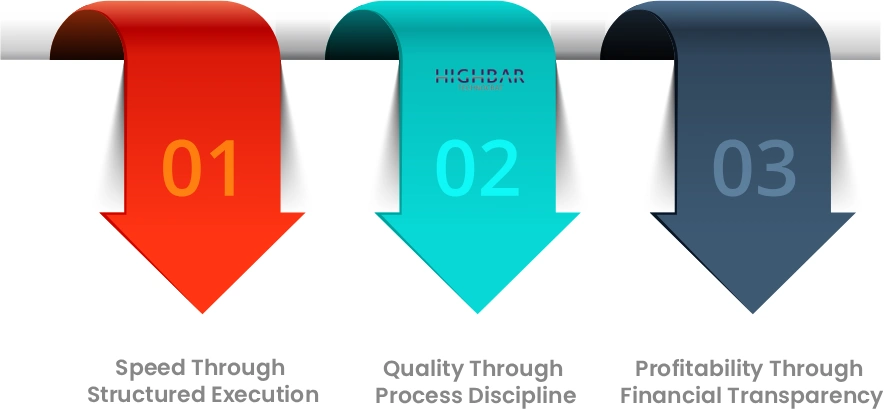
1. Speed Through Structured Execution
Faster project cycle times are achieved by the following for the developers:
- The teams following the set approval paths
- The teams utilizing the budget constraints for the vendor contracts
- The procurement requests following set paths for processing
- The sales bookings being aligned to actual inventory levels
The ERP system also offers a sense of certainty to the developers, as there is no need to reconcile databases, as there is only one data backbone.
It doesn’t just run faster. There’s control in terms of speed.
2. Quality Through Process Discipline
Quality problems tend to occur when there is a lack of visibility in the following ways:
For example:
- Teams are buying material outside of specifications
- Milestones are not aligned to payment schedules
- Inspection results are not related to billing cycles
ERP systems have checkpoints that are hard-coded in the workflow.
The system links all financial entries for a project directly to project milestones. Certified assessments verify progress before teams release vendor payments.
The system also links all documents to their respective transactions. As a result, quality control no longer operates as an isolated monitoring process.
The structure treats quality as a built-in component.
3. Profitability Through Financial Transparency
The profitability of a real estate business depends on margin management, cost predictability, and cash timing.
If there is no integration, then the visibility of finance is lagging behind actual performance.
With SAP, the ERP system for real estate:
- Pre-defined cost centers are managed by teams
- Project budgeting is done in real-time
- Income sources are linked to receipt of milestones
Instead of discovering margin squeeze at the end of the quarter, executives see it while there is still time to respond.
The Role of SAP Cloud for Real Estate
As portfolios expand across cities and asset types, scalability becomes essential.
SAP Cloud for Real Estate extends ERP functionality by providing:
- Centralised portfolio management
- Real-time Dashboards
- Rapid Financial Consolidation
- Unified Compliance Structures
The cloud system ensures that any growth is not accompanied by fragmentation.
This provides a safeguard for developers whose businesses are scaling, ensuring that both their margins and governance are secure.
Developers, like those who utilize structured cloud ERP models, often with the assistance of firms like Highbar Technocrat, are able to maintain consistency in their governance even as they scale aggressively.
The Complex Balance Between Sales Pressure, Financial Control, and Project Delivery
One of the more complex trade-offs in real estate development is the balance between sales momentum, financial discipline, and project delivery.
- The sales team focuses on accelerating bookings.
- The finance team focuses on managing receivables, cash flow, and regulatory requirements.
- The project team focuses on delivering the project as quickly as possible.
In many organisations, these priorities operate independently, and they often conflict with one another.
ERP balances these priorities by integrating them into a single system. Thus, the sales, finance, and project teams no longer operate in cross-purposes, and they now operate in a collaborative effort towards a shared goal.
From Reactive Management to Predictive Control
In many traditional systems, reporting is periodic in nature. This means that by the time problems arise, there are limited options available to solve them.
ERP introduces a new management paradigm, one of predictive control, where:
- Excessive budget expenditure is anticipated
- Discrepancies in cash flow are recognized early
- Cost escalations are recognized
- Revenue generation issues are recognized ahead of deadlines
Programmers no longer make reactive decisions, but proactive ones.
Governance Without Slowing Down
The myth is that more control will result in a slower implementation process.
The truth is that more structured systems actually eliminate the delays that result from confusion.
- Clear systems eliminate the need for approvals
- Automated reporting eliminates the need for consolidations
- Pre-defined cost structures eliminate the need for decisions
Developers who work with structured ERP systems often see that more control doesn’t necessarily mean slower implementation.
The Strategic Outcome: Sustainable Growth
When organisations balance speed, quality, and profitability, they do not eliminate trade-offs by chance. They achieve coordination.
When organisations operate without integrated systems, trade-offs become unavoidable.
When they implement integrated systems such as SAP Real Estate ERP and SAP Cloud for
- Real Estate synergies begin to emerge.
- Defined processes improve operational speed.
- Defined workflows improve execution quality.
- Constant access to financial information stabilises profitability.
Final Reflection
Real estate development no longer focuses only on building quickly and selling rapidly. It now focuses on building intelligently.
Developers who rely on non-integrated systems may create momentum. Developers who implement integrated ERP systems create successful project outcomes.
In today’s competitive marketplace, the ability to manage speed, quality, and profitability together has become essential for success.
Organisations must first establish digital infrastructure because it provides the foundation for structure.
Comments
