



- Global Keynote Recap
- Orlando, FL
- May 11–13, 2026
SAP charts its future as an Autonomous Enterprise company
At Sapphire 2026, Christian Klein staked SAP’s next era on agents that act, not just systems that record. Here’s everything that was announced — and what it means for hybrid landscapes still running ECC.
Business AI Platform
Joule Studio 2.0
Business Data Cloud
Autonomous Suite
Opening
About SAP Sapphire Orlando 2026
At SAP Sapphire 2026 in Orlando, SAP presented one of its most ambitious visions in its history — enterprise software where AI agents, business data, and human expertise work together to run business operations more intelligently.
Throughout the keynote, SAP leaders repeatedly emphasized a central message: the next era of enterprise transformation will not be defined by AI alone. Success will depend on combining AI with business context, governance, process intelligence, and trusted enterprise data.
The result is what SAP calls the Autonomous Enterprise.
The Theme
The Beginning of Better
Opening the keynote, SAP CEO Christian Klein challenged the audience to think differently about technological change. Throughout history, innovation has often been met with skepticism, whether it was the printing press, the internet, cloud computing, or enterprise software itself.
According to Klein, Artificial Intelligence is facing a similar moment today.
He illustrated this point with a personal story about using AI-generated images with his children. While an AI-generated unicorn with three ears might be laughed at as imperfect, that imperfection is sufficient for entertainment — but it would not be sufficient for processing financial supply chain operations, or regulatory compliance.
The brain of every company is ERP.
— Christian Klein, CEO, SAP
For organizations to trust AI with mission-critical processes, solutions must be accurate, explainable, auditable, and governed.
The Platform
Launching the SAP Business AI Platform
To bridge the gap between AI innovation and business execution, SAP officially introduced the Business AI Platform.
- 01 . INTELLIGENCE
Joule AI
The conversational and agentic layer that understands intent across business processes.
- 02 . DATA
Business Data Cloud
A trusted, federated data fabric connecting structured and unstructured enterprise data.
- 03. Trust
Business Technology Partner
The governance, authorization, and compliance layer every agent runs within.
Together, these capabilities provide the foundation for building AI solutions that understand business processes, business rules, authorization structures, and compliance requirements.
SAP’s vision goes beyond simply generating answers. Instead, AI should be capable of understanding business context, accessing the right information, validating permissions, and delivering trusted outcomes.
This platform becomes the foundation of SAP’s broader Autonomous Enterprise strategy.
The Gap
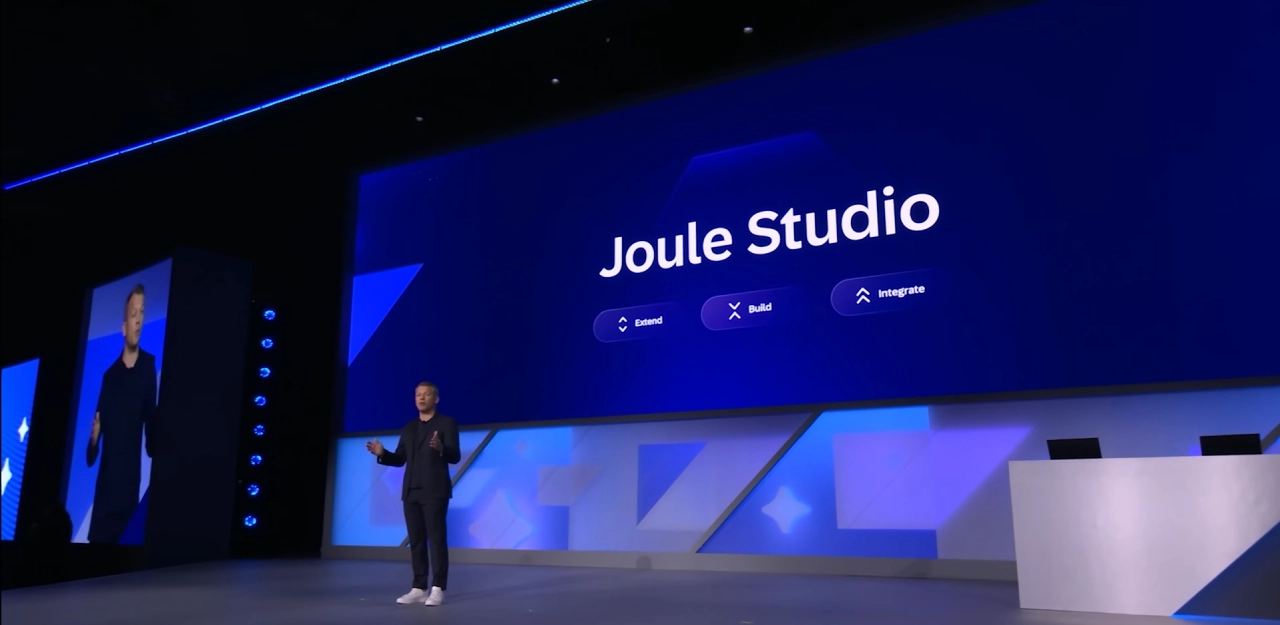
Closing the AI Adoption Gap with Joule Studio 2.0
SAP Chief AI Officer Philip Herzig expanded on this vision by addressing a challenge many organizations face today: despite widespread AI experimentation, very few enterprises have successfully scaled it into meaningful business outcomes.
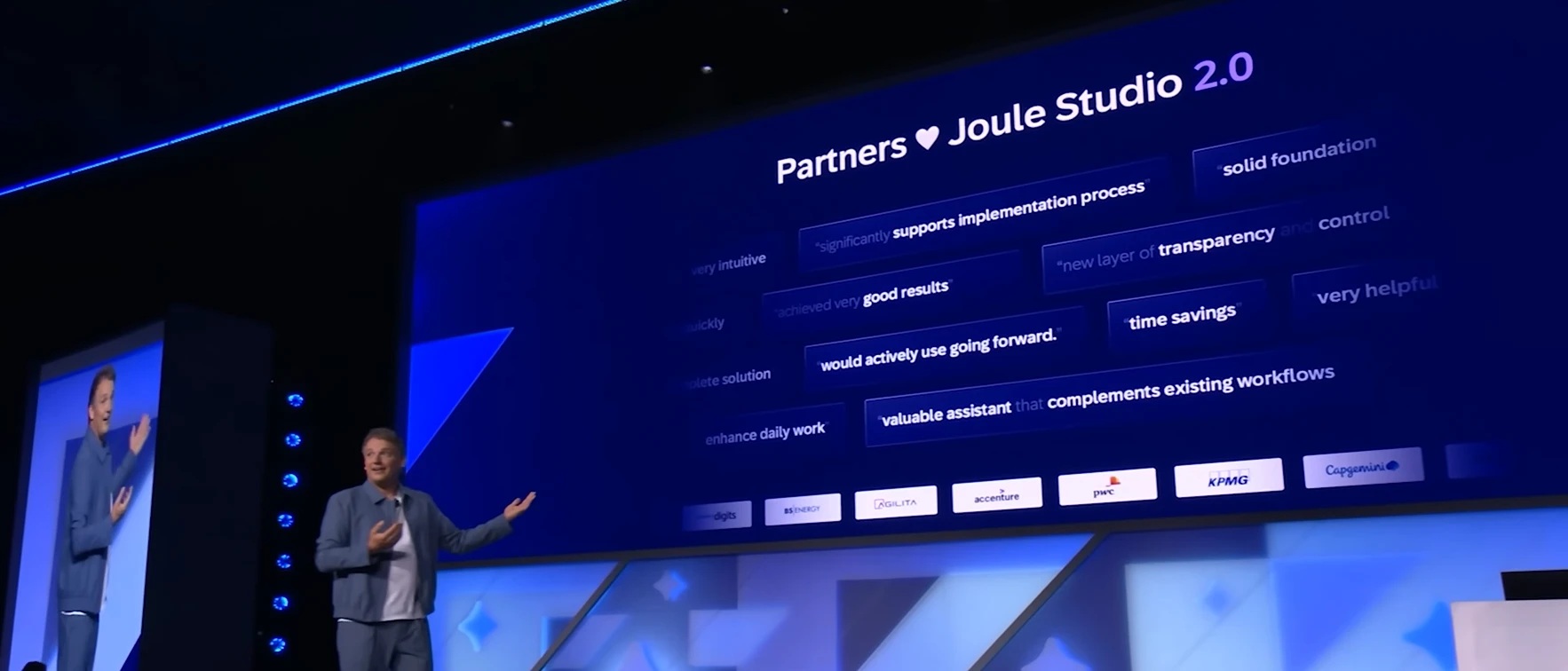
To address this, SAP introduced Joule Studio 2.0.
Rather than requiring organizations to start with technical specifications, Joule Studio begins with business intent.
Instead of writing code, users describe the business outcome they want to achieve.
During the demonstration, SAP showed how an AI agent could analyze a pharmaceutical distributor’s operations and identify approximately $24 million in margin leakage caused by pricing inconsistencies. The agent then recommended building a pricing validation agent to address the issue.
Joule automatically generated requirements, workflows, integrations, testing scenarios, and orchestration logic — then demonstrated reinforced SAP’s belief that future AI development will focus less on coding and more on defining business outcomes.
The Data Fabric
Business Data Cloud and Enterprise AI Reasoning
SAP repeatedly stressed that AI is only as effective as the data behind it.
To solve the challenge of fragmented enterprise data, SAP expanded its Business Data Cloud, describing it as a business data fabric that creates a unified semantic understanding across the business.
0 +
The Data Fabric
$ 0 M
Committed to partner ecosystem
0
New AI agents announced
0
New AI assistants announced
The platform already includes more than 300 SAP-managed data products, enabling AI agents to access trusted business information without organizations having to build complex pipelines from scratch.
SAP also introduced Relio, a new capability designed to create a “golden record” across multiple systems. Whether dealing with customers, suppliers, employees, or products, Relio helps ensure AI operates on a single trusted source of truth.
On the predictive intelligence side, SAP unveiled Rapid 1.5, the next generation of its foundation model for structured business data. Unlike traditional machine learning approaches that often require extensive training and maintenance, Rapid 1.5 enables forecasting, simulations, what-if analysis, and predictive reasoning with greater explainability and transparency.
SAP further strengthened its data strategy through plans to acquire Dremio and Prior Labs, extending its capabilities across distributed data environments and non-SAP data sources.
Trust & Governance
Building trust through governance and partnerships
Another recurring theme throughout Sapphire 2026 was trust.
SAP announced that all AI agents developed on its platform would remain open and interoperable with third-party AI ecosystems. The company also committed more than €100 million to support partners, developers, and customers building AI solutions.
The keynote featured Anthropic, where Claude AI models are being integrated into SAP’s Business AI Platform.
Anthropic emphasized the importance of safety, explainability, and governance in enterprise AI — values that closely align with SAP’s launch. The platform provides centralized governance, monitoring, risk management, controls, and operational visibility for AI agents across the enterprise.
The Application Layer
The Autonomous Suite: SAP's biggest application transformation
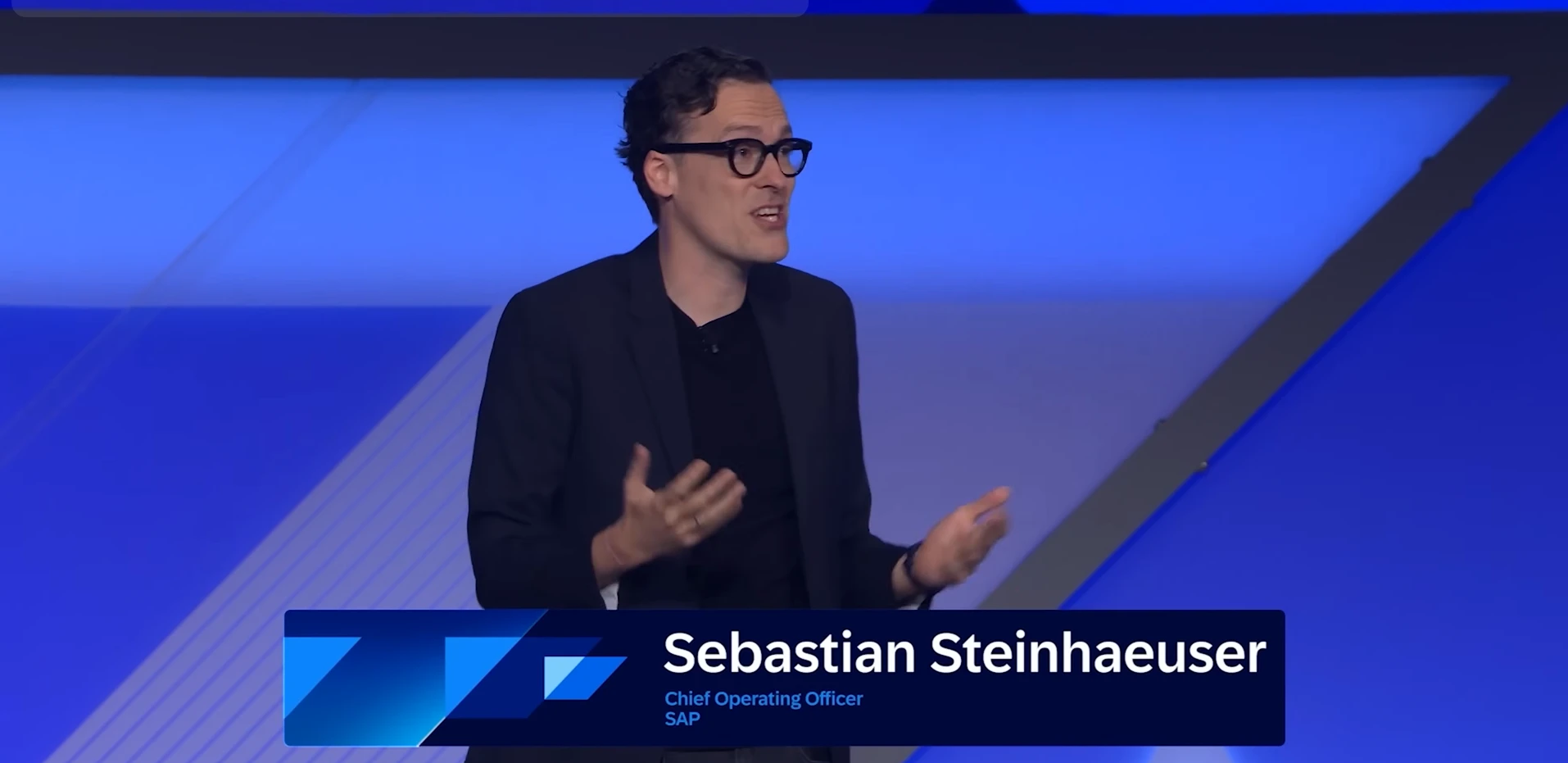
One of the most significant announcements came from Muhammad Alam, who introduced the Autonomous Suite.
For decades, enterprise applications have primarily served as systems of record and execution. According to SAP, the next evolution is systems capable of actively participating in business operations.
The Application Layer
The launch of 224 AI agents and 51 assistants
COVERAGE
Spanning Finance, Spend Management, Supply Chain, Human Capital Management, and Customer Experience
DESIGN INTENT
Built around business outcomes rather than individual transactions
CAPABILITY
Agents monitor, identify issues, coordinate activities, and increasingly execute approved tasks
SAP described this as one of the largest transformations in its application history.
Org Memory
Company Memory: Capturing Organizational Intelligence
Among the keynote’s most discussed announcements was Company Memory.
SAP recognized that much of an organization’s knowledge exists outside transactional systems — in policies, process documentation, approvals, emails, Teams conversations, and employee experience.
Company Memory creates a knowledge layer that allows AI agents to access and learn from this institutional expertise.
As AI agents encounter new situations and successful resolutions, that knowledge is fed back into the system, allowing the organization to become smarter over time.
The capability represents SAP’s attempt to combine public AI models, SAP business context, and company-specific knowledge into a single trusted intelligence engine.
Hybrid Landscapes
AI for Hybrid Landscapes
One announcement that generated significant applause was SAP’s commitment to supporting hybrid environments.
Recognizing that many organizations continue to operate ECC and on-premise SAP systems, SAP confirmed that a large portion of its AI capabilities will extend beyond S/4HANA Cloud.
The announcement reflects SAP’s acknowledgement that modernization is a journey and that customers should be able to benefit from AI while continuing broader transformation initiatives.
INCLUDES
ECC environments
INCLUDES
S/4HANA On-Premise
INCLUDES
Hybrid landscapes running both
INCLUDES
RISE transformation programs
The announcement reflects SAP’s acknowledgment that modernization is a journey, and that customers should be able to benefit from AI while continuing broader transformation initiatives.
User Experience
Reimagining enterprise user experience with Joule
SAP also introduced a bold vision for the future of enterprise interaction.
Through Joule Work Zone and Joule Spaces, the company is moving toward what it describes as an “app-less experience.”
Rather than navigating multiple systems, users will interact with AI-generated workspaces assembled dynamically around tasks and outcomes.
Data, workflows, recommendations, approvals, and notifications are brought together into a single experience tailored to the user’s context.
For SAP, the future is not about better applications — it is about removing friction between people and applications altogether.
Looking Ahead
Industry AI and the next phase of enterprise transformation
The final major product announcement focused on Industry AI.
SAP believes organizations compete not only through business processes but through industry expertise. As a result, Industry AI embeds sector-specific knowledge directly into AI-driven systems.
The first wave of solutions addresses industries such as manufacturing, life sciences, retail, utilities, and consumer goods.
Examples presented during the keynote included autonomous regulated manufacturing, unified commerce, adaptive production, and revenue growth management.
By combining AI with industry-specific identification, controls, and operational requirements, SAP aims to deliver more relevant and actionable outcomes.
Closing
SAP's Final Message
As the keynote drew to a close, Christian Klein returned to a question he had posed at the beginning of the keynote.
- Christian Klein, CEO
"Will SAP be a software company in the future?"
After showcasing the Business AI Platform, Autonomous Suite, Business Data Cloud, Industry AI, and modernization services, the answer came three words later: “SAP is becoming a Business AI company.” Rather than positioning AI as another technology layer, SAP is embedding intelligence directly into business processes, enterprise applications, and operational workflows. For customers, the message was clear: the future of enterprise transformation lies in the combination of AI, business data, governance, and business expertise working together to create the Autonomous Enterprise.
Build an AI-Driven Enterprise with Highbar
Talk to Highbar about accelerating business transformation with SAP and emerging technologies.
On this page
- 1. About SAP Sapphire Orlando 2026
- 2. The Beginning of Better
- 3. Launching the SAP Business AI Platform
- 4. Closing the AI Adoption Gap with Joule Studio 2.0
- 5. Business Data Cloud and Enterprise AI Reasoning
- 6. Building Trust Through Governance and Partnerships
- 7. The Autonomous Suite: SAP's Biggest Application Transformation
- 8. Company Memory: Capturing Organizational Intelligence
- 9. AI for Hybrid Landscapes
- 10. Reimagining Enterprise User Experience with Joule
- 11. Industry AI and the Next Phase of Enterprise Transformation
- 12. SAP's Final Message