

SAP software
Oracle vs SAP HCM Payroll: Which Is Better for Small Businesses?
- Highbar Technocrat
- Blogs
- June 23, 2026
Connect With Us
Payroll problems become serious long before they become visible.
In the early stages, many businesses rely on disconnected processes, email-based approvals, manual corrections, and fragmented HR records. Salaries get processed, compliance requirements are met, and reports are generated when needed.
On the surface, everything seems to be working smoothly. And then the company expands.
The number of employees increases. The policies become complex. There are interactions between leave, attendance, reimbursement, and deduction policies. There are also regulatory issues. The accounting department would prefer to have clear-cut reports. The HR department would prefer that there not be too many manual transactions.
That is the point where many small businesses begin evaluating serious payroll platforms.
And two names often come up in the discussion: Oracle and SAP.
Both are respected enterprise technology brands. Both offer cloud-based payroll capabilities. Both are designed to improve accuracy, control, and compliance. But for a small business, the better choice is rarely decided by brand reputation alone. It depends on business complexity, future scale, process maturity, and the kind of long-term support the company expects from its technology ecosystem.
Oracle positions Payroll as a unified part of Oracle Cloud HCM, while SAP positions SAP SuccessFactors Employee Central Payroll around automated payroll processing, reduced errors, and simplified payroll management.
The real question is not which platform is bigger, but which one is better suited for a small business seeking control today and flexibility for tomorrow.
Why Small Businesses Need to Compare Beyond Features
The purpose of purchasing Payroll software by small enterprises is not limited to processing salaries alone.
These organizations seek a solution for reducing dependence on manual processes, building compliance confidence, integrating Payroll and HR data, and avoiding a bottleneck in Payroll operations. This is the reason why this assessment should extend beyond just features.
A payroll system must align with the business model, the pace of growth, the internal team’s capabilities, and the broader technology environment.
This matters because a small business has fewer buffers. It cannot afford a long implementation cycle, frequent workarounds, or heavy reliance on specialists for administrative support. It needs a system that is practical, scalable, and sustainable.
This is exactly where the Oracle vs SAP comparison becomes more meaningful.
The Real Challenges Small Businesses Face with Payroll
Before comparing Oracle and SAP, it helps to understand what smaller companies are actually trying to solve.
They want to steer clear of payroll errors that would harm their relationship with employees. They want to remain in compliance without overburdening the HR department. They want to decrease the manual labor involved in calculations, validation, and rectification.
In many cases, they are also trying to connect Payroll to the rest of the business.
That connection matters. Oracle emphasizes a unified HCM and ERP cloud model with a common data model across finance and HR. In contrast, SAP’s payroll approach emphasizes real-time insights, alerts, and continuous payroll controls through Payroll Control Center.
For a small business, that difference is important.
One platform leans strongly into end-to-end unification. The other leans heavily on controlled payroll processing within a broader SAP environment.
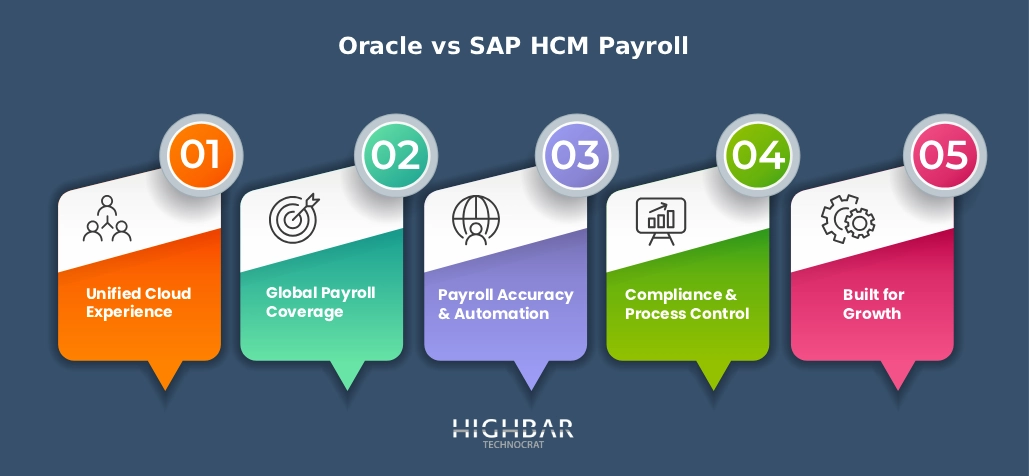
Oracle vs SAP HCM Payroll: Where the Real Difference Appears
1. Oracle often feels simpler for businesses wanting one unified cloud environment
Oracle Payroll is positioned as a fully unified part of Oracle Cloud HCM. Oracle also highlights that the platform works across industries, company sizes, and worker types. That makes Oracle attractive to small businesses that want HR and Payroll to sit within a single, tightly connected cloud model from the start.
For a smaller company with limited internal IT involvement, this can feel easier to manage.
The value is not only in payroll processing. The value is in reducing the disconnect between employee records, workforce processes, and payroll calculations.
Oracle also promotes a unified HR-and-finance cloud experience that can appeal to businesses seeking cleaner cross-functional visibility as they grow.
2. SAP becomes stronger when payroll accuracy, control, and SAP ecosystem alignment matter more
SAP SuccessFactors Employee Central Payroll is designed with the aim of automating the payroll process and making it faster, minimizing mistakes. SAP emphasizes continuous payroll, predictive insights, anomaly detection, and resolution assistance via Payroll Control Center.
That gives SAP a different kind of strength.
Instead of presenting Payroll as part of a broad HR suite, SAP treats it as a control-driven business process that benefits from structured validation and exception handling. For small businesses that already use SAP software elsewhere, or expect to grow into a more process-heavy operating model, that matters.
Also stated by SAP is the fact that Employee Central Payroll supports 50 locales, which is relevant to companies anticipating multiple country challenges in the future.
3. Oracle can be attractive for smaller teams that prioritize ease and broad global coverage
Oracle promotes compliant, configurable Payroll worldwide and states that businesses can pay employees in over 200 countries with ease through its payroll capabilities and related offerings. It also emphasizes highly configurable rules and a scalable processing engine in its payroll documentation.
For small companies looking to enter the international market, this message is convincing.
It conveys diversity, adaptability, and an easier entry point for managing payroll across the globe. If the organization wishes to have one cloud provider with a large number of HR technologies, Oracle will definitely be considered right away.
4. SAP can be the better long-term choice when the business wants stronger process discipline and partner-led evolution
Here’s where the dialogue shifts.
Small companies do not tend to stay small in terms of the complexity of operations. Regardless of how the number of people in the company stays moderate, as the size of the organization grows, the complexity of payroll, compliance, commissions, and business becomes more significant. As such, the selection of the platform must consider both these aspects.
SAP is able to deliver much here. The SAP Enterprise Support offers what is needed for the clients to embrace and grow SAP solutions, whereas the customer interaction center provided by SAP offers 24/7 service on important matters.
That becomes even more relevant when the business works with a partner that understands implementation and long-term SAP support in context.
Highbar Technocrat publicly positions itself as an SAP Gold Partner with application support, upgrades, migration, business process consulting, and industry-focused SAP transformation capabilities. Highbar Technocrat also emphasizes ongoing support to maintain and optimize SAP system performance.
For small businesses that want SAP software to remain useful after go-live, that support mindset matters.
5. Small businesses should not ask which platform is better in general. They should ask which one is better for their next stage.
This is where many evaluations go wrong. They compare features without comparing operating reality.
For organizations that need an extensive, cohesive cloud HR environment that is centered on Payroll services, Oracle could turn out to be a good choice. For organizations that prioritize payroll control, scalable solutions within the SAP environment, and reliable SAP support via effective partnering, SAP becomes a better choice.
The key differentiators for Oracle are its focus on cohesive HCM processes and 24×7 support services in India. For SAP, these are payroll automation, payroll control, and structured support services. Ultimately, the choice is a strategic one.
Why This Decision Matters More Than It Appears
Payroll software for small companies is more than a mere Human Resources system.
The payroll software impacts trust, confidence in compliance, the quality of reports generated, and managerial efficiency. The payroll software impacts the ability to detect any problem, employee compensation, and scalability of operations without requiring increased manpower.
This is why platform choice should not be treated as a short-term software purchase.
It should be treated as an operating decision. A business that chooses Oracle may gain a unified cloud path that feels simpler at the start. A business that chooses SAP software may gain stronger payroll discipline, a better fit inside a broader SAP-led environment, and more durable value when paired with the right SAP support partner.
That is also where Highbar Technocrat becomes relevant, because Highbar Technocrat does not position SAP as a standalone product. It positions SAP as part of a larger business transformation journey supported by implementation, enhancement, and ongoing support.
Final Thoughts
Therefore, is it better for smaller businesses to use Oracle or SAP HCM Payroll?
In honesty, there are pros for each side. However, each software fits better into the needs of the company based on its priorities.
Oracle is more likely to be the better option when the goal is a fully integrated cloud solution with comprehensive global capabilities for HR and payroll. On the other hand, SAP will be the preferred software when the priority is strict control of payroll processes.
For many growth-oriented businesses, the better question is not only which software looks easier today, but also which software will be easier tomorrow.
It is the question of which platform will still support the business well as headcount grows, policies expand, and Payroll becomes more complex.
This is the point at which software from SAP, combined with professional support for SAP services, often proves to be the right investment.
This is one of the reasons why companies considering SAP need to go beyond product information and focus on implementation, business know-how, and support through the journey, which is what Highbar Technocrat has been doing all along.
Related Blogs