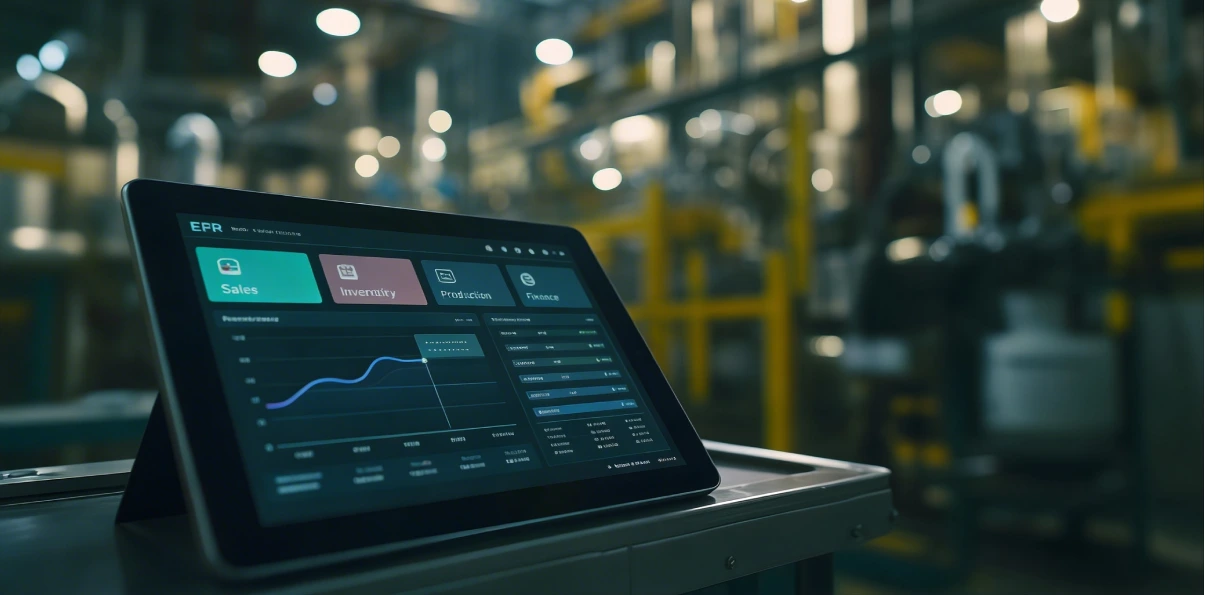



ERP MES Integration
From Shop Floor to P&L: ERP Visibility Manufacturing CFOs Need
- Highbar Technocrat
- Blogs
- April 10, 2026
Connect With Us
Every CFO in the manufacturing business has been in this situation before. Operations tells the CFO that production efficiency is up, the factory is producing more units, and inventory is stable. But when the data gets to the P&L statement, the margins start to erode, working capital is being stretched, and the cash flow is becoming less predictable.
Somewhere between what happens on the factory floor and what appears in the financial statements, the organisation loses clarity. This is not just an operational issue. It is fundamentally a visibility issue. In modern manufacturing environments, CFOs cannot afford a fragmented understanding across functions.
It is here that a good SAP ERP solution is considered essential, not only as a back-office solution but also as a key solution for visibility that links reality and truth financially.
The CFO’s Core Frustration: Data Without Context
Manufacturing environments generate vast amounts of data on machine availability, production volumes, scrap rates, labour hours, inventory movements, and procurement transactions.
The challenge does not lie in the absence of data, or even in the absence of financially relevant data. The challenge emerges when these systems do not integrate with one another. In such cases, the focus of operations is on efficiency, and the focus of finance is on cost pressure.
While these may be correct approaches from different points of view, these approaches are not correct by themselves. Hence, the CFO needs a single view of ERP that shows the impact of downtime on cost per unit, the impact of overtime on profit per unit, the impact of scrap on profit, and the relationship between inventory and cash flow.
Without this perspective, the relationship between efficiency and financial performance is unclear, and decision-making is extremely challenging.
Why Month-End Reporting Is Too Late
Traditionally, the reporting system was geared towards supporting slower markets. Today, the uncertainty of raw materials, energy costs, and demand can result in the financial performance changing weeks, even days.
Organisations are not aware of cost overruns and margin erosion until the end of the month. This means that the response to the situation is also too late.When organisations design the SAP ERP application effectively, they can link shop floor activities directly to the financials. Confirmation of production, movement of materials, and issuance of materials can update the general ledger in real-time.
This enables CFOs to transcend the summary level and access transactional data with direct links to the financial impact. As a result, the speed and quality of decision-making improve significantly.
Connecting Production to Profitability
One of the most valuable uses of ERP visibility lies in profitability analysis. It is possible that two product lines can show similar trends in revenue growth, but one product line is quietly absorbing more overtime, machine changeovers, and scrap. Without the visibility provided by ERP, both product lines will appear to have similar profitability.
With ERP visibility, the system will assign labour costs to each production order, machine hours will be accurately recorded, and scrap costs will be captured in real-time. This gives the CFO a clear view of true contribution margin by product. This is not theoretical accuracy. It is an operational truth.
Inventory: The CFO’s Silent Risk
Inventory is often the largest asset held by an organisation, but many organisations are not aware of the true nature of the asset. Disjointed systems often result in blind spots such as inaccurate valuation, slow-moving stock, underlying obsolescence, and procurement decisions.
The SAP ERP system offers real-time centralised inventory valuation through the integration of procurement, production, and sales. This means that stock valuation is immediately reflected in financial reports, accounting entries are made immediately depending on the movement of the stock, cost of goods sold is captured correctly through the cost of production, and working capital risk is immediately visible.
This means that the CFO does not have to consider the static asset known as the inventory on the balance sheet; rather, the inventory is now a dynamic control lever.
Variance Analysis in Real Time
Many organisations treat variance analysis as a post-mortem exercise that compares planned performance against actual outcomes and budget against reality. However, by the time finance is ready to analyze a variance, operations have already moved on to the next production cycle. With ERP integration, material price variances are immediately visible, production order cost overruns are detected in real time, and labour efficiency variances are visible on a daily basis. This helps CFOs shift from being reactive in variance analysis to being proactive in cost control.
Cash Flow Visibility Across Operations
However, cash flow does not originate in finance; it originates on the shop floor. Production delays impact the timing of invoices, procurement delays impact the timing of payables, and inventory management also has an impact on cash flow.
This provides CFOs with forward visibility of cash flow, directly linked to operations performance. This provides a more accurate forecast, thereby giving greater confidence to the board.

Why Implementation Quality Matters
ERP visibility is only as strong as its configuration. Poor master data, weak integration, incorrect cost centre structures, and poor governance can compromise the entire system. That is why choosing the right ERP implementation partner is not merely an IT decision.
It is a financial decision. A competent partner will deliver an accurate cost structure, clean master data, financial integration, operations and finance alignment, and strong controls. Without these, ERP is simply one more reporting vehicle. With these, ERP is a powerful asset.
Aligning Operations and Finance
One of the most subtle, yet most impactful, effects of ERP integration is the concept of “alignment.” In a non-integrated environment, operations and finance frequently disagree on the numbers.
An integrated SAP ERP solution changes this by giving both operations and finance the same numbers, thus directly linking operations activity to financial impact and creating shared responsibility.
If operations take a rush order, finance can instantly see the impact on margins. If purchasing gets price reductions, operations can instantly see the impact on costs.
The Strategic Role of the Manufacturing CFO
Modern manufacturing CFOs: CFOs in modern manufacturing businesses are no longer just financial gatekeepers; they are strategic advisors, risk managers, growth enablers, and digital transformation leaders.
To be effective in these roles, they need to have visibility across the enterprise, not just disparate information. At Highbar Technocrat, ERP transformation initiatives often focus on strengthening this operational-financial linkage. When shop floor data flows seamlessly into financial reporting, leadership can make faster and more confident decisions. ERP is no longer only about compliance. It is about control.
Scaling Without Losing Financial Discipline
As manufacturers expand into new plants, geographies, and product lines, complexity increases rapidly. Without the right systems, financial discipline weakens. An effective SAP ERP implementation ensures consistency across all plants by establishing common costing logic, a unified reporting structure, centralised data management, and standardised financial controls. Growth does not have to reduce visibility.
With the right ERP foundation, growth can actually improve visibility. This is where partnering with the best ERP implementation partner creates a meaningful difference.
Final Reflection
Many manufacturing organisations struggle in the gap between shop floor activity and the P&L. When that connection remains weak, decisions get delayed. If such a link remains in a state of fragmentation, profitability becomes unpredictable. A well-configured SAP ERP system bridges such a gap.
It converts machine hours to cost per unit, links scrap to margin impact, and links delays to cash flow forecasts. A well-written transformation guide, such as “Highbar Technocrat,” enables ERP to be more than just a reporting tool. It becomes strategic control for manufacturing CFOs. In modern manufacturing, this is no longer optional. It is essential
Related Blogs