



ERP Implementation Partner
GST, Contract Variations & Claims: ERP as the Single Source of Truth
- Highbar Technocrat
- Blogs
- April 13, 2026
Connect With Us
In infrastructure, EPC, and large real-estate projects, complexity does not arise from execution alone, it arises from compliance layered over execution.
GST regulations, contract variations, interim claims, counterclaims, and certifications operate simultaneously, often across multiple stakeholders.
However, many businesses are still dealing with these key aspects in a disorganized manner, using spreadsheets for GST, emails for contract modifications, accounting software for billing, and paper documentation for claims.
It is exactly because of this that disputes are escalating, audits are raising red flags, and margins are quietly shrinking.
A well-implemented ERP system changes this reality by acting as a single source of truth, provided it is designed and deployed by the right ERP implementation partner with deep infrastructure and compliance expertise, such as Highbar Technocrat.
The GST–Contract–Claims Challenge in Infrastructure Projects
Infrastructure projects rarely fail because teams do not work hard enough. More often, they fail because systems, processes, and data do not move in sync.
GST Complexity Across the Project Lifecycle
In infrastructure projects, GST is not limited to invoicing alone. It touches multiple stages of execution and financial management, including:
- Different GST rates are applicable to materials and services used on the project
- The project milestones and professional certifications establish the eligibility criteria for input tax credit.
- The GST rules determine how rallying refinements and retention amounts should be treated.
- The time-of-supply provisions establish the GST collection schedule for each milestone- based billing
When GST data is handled separately from project and contract systems, errors and mismatches become unavoidable, leading to compliance gaps, audit observations, and disputed claims.
Contract Variations Are the Norm, Not the Exception
Change orders, scope expansions, and design modifications are part of every infrastructure project. However, problems arise when:
- Variations are approved operationally but not financially.
- Contract values are not related to billing and GST calculations
- Claims are submitted without system-supported cost substantiation
These weaknesses are considered governance failures by auditors and tax authorities.
Claims Without System Traceability Invite Disputes
Claims, whether for delay, escalation, or scope change, must have traceability on the following:
- Reference to the contract clause
- Cost implications
- GST implications
- Approval chain
Use of manual claim tracking systems can result in claims being disapproved or even rejected. prolonged arbitration.
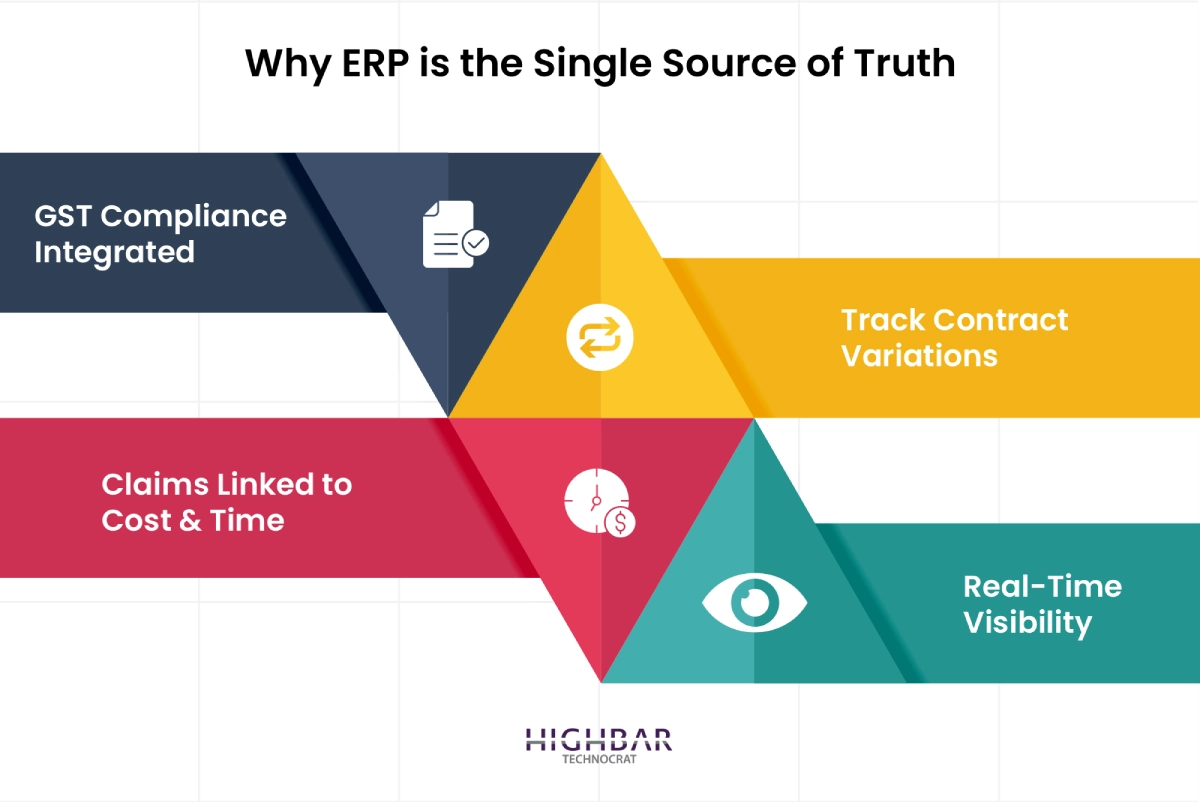
Why ERP Must Be the Single Source of Truth
The ERP system functions as more than accounting software. The control spine for infrastructure projects uses performance data and financial information, and compliance metrics to manage project operations.
1. Integrated GST Compliance With Project Data
The ERP system provides GST integration for these business processes:
- Procurement
- Contract billing
- Advances and retention
- Input tax credit reconciliation
The GST calculations are automatically synchronized with the project milestones and contracts, thus minimizing the risks of GST compliance and audits.
Such high levels of integration can only be achieved when the ERP system is properly set up by an experienced ERP implementation partner and not by generic installations
2. Contract Variations Tracked End-to-End
ERP enables:
- Version-controlled contracts
- Approved variation orders linked to revised budgets
- Automatic update of billing values and GST impact
- Visibility into original vs revised contract value
The system solves a frequent audit problem which occurs when the field staff approves work, but the financial department cannot locate the documentation.
3. Claims Associated with Cost, Time, and Compliance
With ERP:
- Claims are made against system-recorded cost overruns
- Supporting documents are stored centrally
- GST treatment is done correctly
- The financial effect is apparent before escalation
Claims become data-driven, not narrative-driven—much easier to recover successfully.
4. Real-Time Visibility for Management & Auditors
The ERP dashboards show two main results, which include the following evidence:
- GST liability versus ITC availability
- Contract value consumption
- Uncertain claims and certifications
- Financial risk exposure because of variations
The system helps organizations to prepare better for their audits and mandatory assessments.
The Role of SAP ERP in Infrastructure Governance
Platforms such as SAP ERP are widely adopted in infrastructure because they support:
- Complex contract structures
- Multi-location GST compliance
- Large transaction volumes
- Strong audit trails
However, the platform alone does not guarantee success.
Why Choosing the Right ERP Implementation Partner Is Crucial
- The Infrastructure ERP implementation goes wrong when:
- Industry-specific business processes are not taken into account
- GST parameters are treated as generic
- Contract and claim calculations are too simplistic
An experienced partner for ERP implementation understands:
- EPC and infrastructure contract structures
- GST complexities in the Indian construction and service sectors
- Claims, LDs, and escalation procedures
- Audit and compliance requirements
This is where partners like Highbar Technocrat differentiate—by aligning SAP ERP capabilities with on-ground execution and regulatory realities.
Organizations that function on a regional level can benefit from the availability of expert SAP ERP support in Mumbai, ensuring quicker stakeholder coordination and post-go-live support.
ERP as a Risk Mitigation and Margin Protection Tool
When ERP becomes the single source of truth:
- GST leakages deflate
- Claims recovery enhances
- Contract disputes decline
- Audit outcomes strengthen
- Financial forecasting becomes responsible
Instead of reacting to disputes, organizations prevent them structurally, an approach consistently seen in ERP programs delivered by Highbar Technocrat.
Conclusion: One System, One Truth, Fewer Disputes
GST complexity, contract interpretations, and claims are unavoidable in infrastructure projects. What is avoidable is chaos.
ERP implemented correctly replaces fragmented records with structured governance. It ensures that every rupee billed, every variation approved, and every claim raised is consistent, compliant, and defensible.
For infrastructure organizations serious about scale, compliance, and profitability, partnering with the right ERP implementation partner and leveraging expert SAP ERP services in Mumbai is no longer optional; it is strategic.
Because in high-value projects,
The organization that controls its data controls its risk.
Related Blogs