





Why Real Estate Sales Forecasting Fails Without ERP
- Highbar Technocrat
- Blogs
- March 18, 2026
Connect With Us
Why Real Estate Sales Forecasting Fails Without ERP Integration
Sales forecasting forms the basis for all decisions in the field of real estate, shaping the dynamics of real estate firms’ strategies on matters such as price, cash flow, construction, finance, and investment. In spite of its importance, sales forecasting remains unreliable in the field of real estate organisations.
Projects take off with rosy projections, but soon they face financial squeezes, delays in construction phases, buildups of inventories, and funding shortages.
The issue is not market uncertainty. The real problem is Fragmented Data and Systems.
Without ERP integration, real estate sales forecasts are built on partial information, outdated assumptions, and manual reconciliation—making failure almost inevitable.
The Illusion of Accuracy in Traditional Sales Forecasting
Many real estate developers still rely on:
- Standalone CRM systems
- Excel-based sales trackers
- Manual booking reports
- Periodic finance updates
Individually, these tools seem useful. Together, they don’t converge on a single coherent vision of reality.
- Sales teams could report strong bookings.
- Finance teams may face delayed collections.
- Project teams can be confronted with construction delays.
Yet none of this gets integrated into a single forecast.
Where Sales Forecasting Breaks Down Without ERP
1. Disconnected Sales, Finance, and Project Data
Sales forecasts usually take into account the fact that
- The bookings will vary accordingly
- Those that will be made will follow a regular schedule.
- The construction will be done in one continuous process
In reality, customer defaults, construction holds, and approval holds have a direct effect on cash flow. Without ERP system integration, this situation remains undercover until a problem occurs.
2. No Real-Time Visibility into Collections
One forecasting error sometimes made is relating bookings to revenue.
Without ERP:
- Sales teams monitor the contracts
- Each finance is tracked separately
- Ageing, defaults and rescheduling are not comprised in forecasts
This leads to over-inflated revenue forecasts and inadequate cash flow planning.
3. Inventory status is not related to sales forecast
There may be unsold inventory, blocked units, or layout changes that exist outside the forecasting method.
Without ERP Integration:
- Available inventory is overstated
- Sold but not registered units are miscounted
- Project-wise Absorption Paces are deformed
However, forecasts will lose their reliability if inventory reality does not support such projections.
4. Construction Delays are Ignored in Sales Planning
Sales forecasts sometimes depend on certain assumptions regarding the satisfaction of the schedule for ownership access.
But when construction schedules slip:
- Delayed Consumer payments are postponed
- Cancellations rise
- Revenue recognition
Without ERP connecting construction progress to sales and finance, forecasts remain disconnected from execution reality.
Why ERP Integration Changes the Forecasting Game
ERP integrates sales, finance, construction, and inventory into a single system of record.
Instead of forecasting based on assumptions, organisations forecast based on live operational data.
This is where SAP real estate implementation services
play a critical role—aligning systems with how real estate projects actually function.
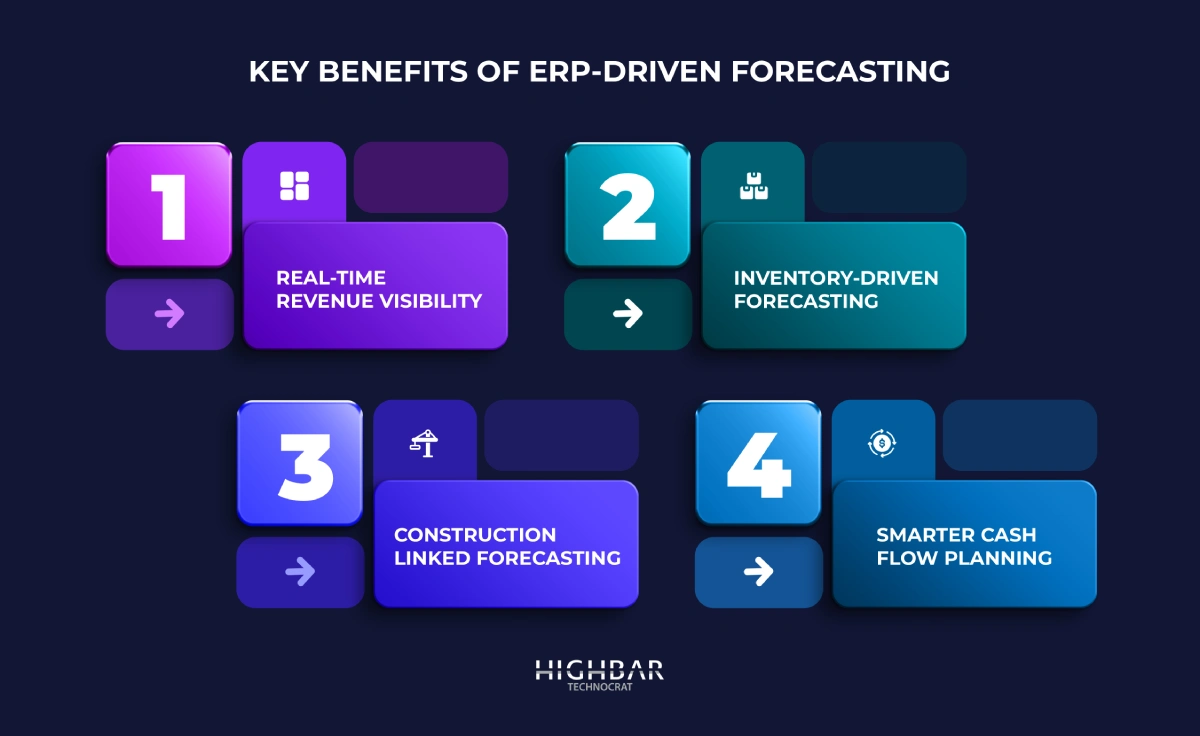
How ERP Improves Real Estate Sales Forecasting
1. Unified View of Bookings, Collections, and Revenue
ERP links:
- Sales agreements
- Payment schedules
- Actual collections
- Revenue recognition rules
The forecasts are updated in real time as the customer’s behavior changes, making them more accurate and reliable.
2. Inventory-Driven Sales Pro
With ERP:
- Inventory status is updated in real time
- Availability of units is based upon approval, blocks, and revisions
- Project-wise, the rate of absorption is monitored
Sales forecasts become grounded in actual supply, not assumptions.
3. Construction Progress Directly Impacts Forecasts
ERP integrates milestones of projects with:
- Customer Billing Triggers
- Possession-linked payments
- Revenue recognition
When construction activities slow down or speed up, the forecasts will automatically adjust—keeping the leadership apprised and advancing accordingly.
4. Better Cash-Flow and Funding Planning
With accurate sales forecasting, the following benefits:
- Reliable cash flow projections
- Improved loan drawdown planning
- Reduced funding surprises
Finance teams advance from reactive cash management to proactive capital planning.
The Role of SAP Real Estate ERP
Platforms such as SAP Real Estate ERP are designed to handle:
- Project-wise sales tracking
- Customer lifecycle management
- Complex payment schedules
- Regulatory and compliance requirements
- Integrated finance and construction data
However, the platform’s success depends entirely on how well it is implemented.
Why Implementation Matters More Than Software
Many ERP projects fail to improve forecasting because:
- Sales processes are not fully integrated
- Construction data remains manual
- Finance rules are applied too late
- Reporting is designed for operations, not leadership
Effective SAP real estate implementation services ensure:
- End-to-end process integration
- Real-time data capture
- Forecast models aligned to execution reality
- Dashboards designed for decision-makers
ERP becomes a forecasting engine—not just a transaction system.
What Leadership Gains from ERP-Driven Forecasting
With ERP-based integrated sales forecasting, managers can:
- Predictable cash flows
- Better pricing and launch methods
- Increased investor and lender confidence
- Reduced inventory risk
- Faster, Data-Based Decisions
The pain of forecasting becomes the gain of strategy.
Conclusion: Forecasts Fail When Systems Don’t Talk
Real estate sales forecasting does not fail because teams lack experience. It fails because systems operate in isolation.
Without ERP integration, forecasts are built on incomplete data and delayed insights. With ERP—especially when powered by robust SAP real estate implementation services—forecasting becomes accurate, dynamic, and dependable.
Because in real estate,
The quality of decisions hangs on the quality of data behind every forecast.
Comments
